Topic D:
The Impact of Doctor Migration on Medical Doctors Education
and Residency (medical specialists) Training
13 May 2014
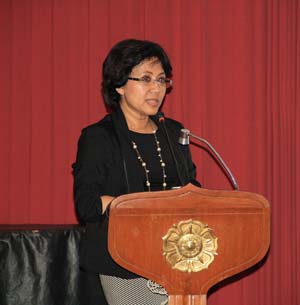 This session was given by representatives from Indonesia and Thailand. Health education in the future should be improved in order to support the ability of health professionals to face the challenges of an increasingly complex future. This was stated by dr . Ova Emilia , M.Med . Ed.Sp.OG ( K ) , PhD in the last session of the first day of the event Postgraduate Forum on May 13, 2014. Specified future not only of the exact path. According to dr . Ova , many ways you can do to improve the competence of health personnel, among others, not only related to education alone but also related to the real world. The first way is Practice based Learning and Improvement. These competencies to improve the ability to fix an error, use of technology in decision making, knowing the areas that must be improved to be more enhanced insight, skill, attitud, and maintenance processes.
The second point is a Systems Based Practice , the goal of competence is the ability to understand, access, and resource and support system for service. Understanding the advantages and disadvantages of a system and trying to find a way out in order to improve services. Using the evidence and common purpose in the prevention, diagnosis and action . Establish good cooperation with colleague health professionals to better serve patients facing complex systems.
Additionally dr . Ova Emilia , M.Med . Ed.Sp.OG ( K ), PhD states that there is a form of training in the future must be obtained by a doctor: to develop the ability to understand the needs of the patient’s physician, the clarity of duties / work area general practitioners and specialists, Continue professional development (CPD) is a requirement importantly, the achievement of broader expectations for the training phase of postgraduate ( master general abilities such as leadership, communication, orientation on quality and patient; adapt themselves to work in teams ; quality training) . Application of a new form of training will bring pressure from within and outside the educational environment. Limited resources, must bring in new teachers, need a great effort to change the old express their views is the pressure of the educational environment. External pressures include enjoy unlimited time because they have to share the work time, changes in services, the demand of safety service that is currently booming, increased productivity and great complexity of an increase in knowledge.
Wanicha Cheungkongkeuw (Thailand)
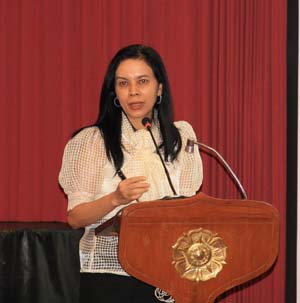 Lack of health workers in Asia , especially Southeast Asia threatens to hamper the effectiveness of health care quality health announced by the government in each country . This was disclosed by Wanicha Chuenkongkaew . the Postgraduate Forum , WHO estimates that the ratio of physicians to population if less than 2.3 health workers per 1000 population effectiveness of health care will not be achieved. In comparison with developed countries like the U.S. which touched 12.3 Southeast Asia only touched 1.6 .
The cause of the lack of health workers due to several reasons, among others: the low level of acceptance and the high cost of education, less follows a curriculum, financing is not smooth, career uncertain, troubled institutions, the investment is not in place, and organizers are questionable accreditation. In response to this kind of thing then formed a forum of health education reforms in many countries, especially in Asia so that the education system in this area can be improved. Then in 2011 formed the Asia-Pacific Network on Health Professional Education Reform ( ANHER ) .
Wachita on this occasion expressed ANHER goal is to create and strengthen cooperation regarding the region ‘s health education professionals. Besides increasing the knowledge of health professionals in order to quickly respond to problems in the health system that is always changing and growing. Successful reform of health education to be relevant to the health system and in accordance with social needs in each country.
In order for the above purpose is achieved ANHER implement several attempts, among other things, the first to use a general rule in the survey analysis of the situation. Then, share experiences on effective innovation and improvement of training is getting better in every country. Finally, we should prioritize collaboration among the five countries, namely Bangladesh, China, India, Thailand, and Vietnam .
Reporter : Harumanto

 Today begins the presentation by Prof. Abdul Kusnanto with research citing Omran (1971), the three stages of modernization which are classified by cause of death: (1) Pestilence and famine; (2) receding pandemics; (3) degenaritve and man-made disease.
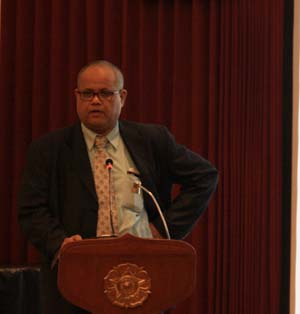 Presentation of Prof. Syed Aljunid describes how he observed UHC applications globally, which 192 countries have UHC implementation issues . He began with an explanation of what is UHC, in which he explains that the UHC is a society have equal access to health services. Then proceed with the three dimensional aspects of UHC and also aspects that affect UHC.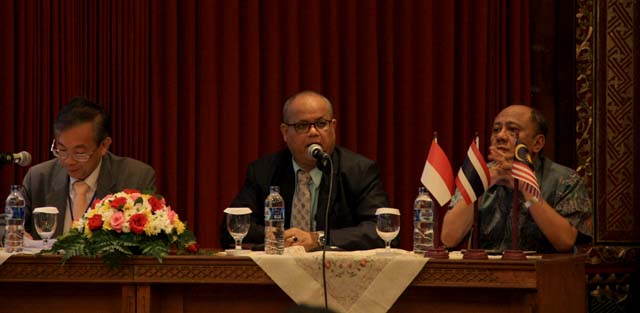

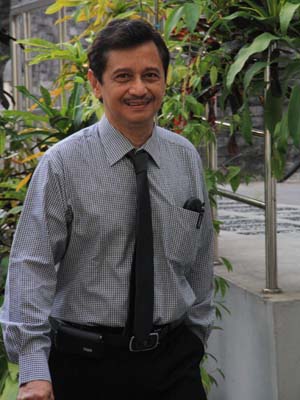 This forum launched by Dean of Faculty Medicine, GMU, Prof. Dr. dr. Teguh Aryandono, Sp.BO (K). He highlighted the relationship between the recent findings in epidemiology and the future challenges in health sector. The challenges would be varied among ASEAN countries. Moreover, with the different international regulation on health personnels distribution, which have an important role in affecting the development of health systems and human health resource management. Therefore the postgraduate forum is very important as a media to share recent knowledge on health sectors, in particular: epidemiological transition, doctor supply, doctor migration, and various topics on health systems.
 Introduction
 The discussion series aim to:
 JADWAL KEGIATAN
 PESERTA
 PENDAFTARAN DAN INFORMASI


 Tujuan dari presentasi adalah membahas pentingnya dan pengaruh dari fungsi pembiayaan, menggambarkan efek pembiayaan pada equity dan efisiensi, serta mengidentifikasi isu fungsi pembiayaan di negara-negara SEAR. Telah terjadi health financing transition yang memiliki implikasi luas pada kesehatan masyarakat, equity, dan pertumbuhan ekonomi. Peningkatan sumber daya dan peningkatan pembiayaan kesehatan untuk masyarakat luas akan meningkatkan status kesehatan secara umum. Health financing transition ditandai dengan semakin besarnya pembiayaan pelayanan kesehatan di negara-negara kaya dan meningkatnya kesehatan masyarakat di negara-negara tersebut. Secara nyata, HFT ditandai dengan peningkatan belanja kesehatan per orang dan menurunnya angka out-of-pocket spending (OOP). HFT menggambarkan terjadinya perubahan pola pembiayaan kesehatan di suatu negara (
  Negara LMIC (low and middle income) memiliki konteks: pertumbuhan ekonomi yang lambat, terjadinya subsidi silang, dan rendahnya kinerja provider. Data menunjukkan bahwa pertumbuhan ekonomi di Asia mencapai 7,2% (1999-2008), namun ini hanya didorong oleh beberapa negara. Pada sisi lain, 105 juta orang mengalami kesulitan untuk membiayai pelayanan kesehatan dan 70 juta orang jatuh miskin oleh karena menderita peyakit katastropik. Dalam situasi seperti ini, banyak negara mengejar tercapainya status UHC. Saat ini, UHC status di China dan Mongolia mencapai 80% dan Indonesia, Vietnam, Philipina mencapai 60%
 Pertanyaan terbesar dalam memilih metode pambayaran adalah: pelayanan/intervensi kesehatan seperti apa yang harus dibeli (penilaian dilakukan pada 2 aspek yaitu: efek financial protection dan cost-effectiveness), Bagaimana cara membeli pelayanan kesehatan tersebut (penilaian dilakukan dengan melihat model kerjasama hirarki atau kontrak, tingkat pengambilan keputusan, dan metode pembayaran), dan dari mana pelayanan kesehatan tersebut dibeli (penilaian dilakukan dengan melihat status organisasi: public, private not for profit, atau private for profit). Pengambilan keputusan pada penetapan benefit package selalu menjadi tantangan oleh karena banyaknya faktor teknis yang perlu dipertimbangkan, diantaranya: cost effectiveness (biaya dengan QALY), ketersediaan sumber daya, dan dana yang tersedia.