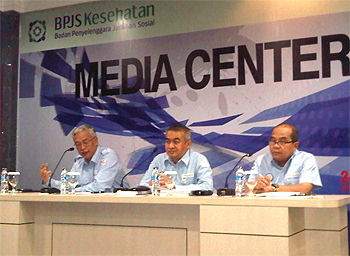
Kasus Suspect Ebola di Indonesia Sudah Lima Kali

Direktur Surveilans, Imunisasi, Karantina, dan Kesehatan Matra, Direktorat Jenderal Pengendalian Penyakit dan Penyehatan Lingkungan, Kementerian Kesehatan, dr Wiendra Waworuntu mengatakan dugaan suspect ebola di Indonesia sudah terjadi empat lima kali. Beberapa waktu lalu, tiga warga Jakarta dan Medan yang baru pulang dari Nigeria juga terindikasi terpapar penyakit ini.

“Yang baru, kasus suspect ini dialami dua warga Madiun dan Kediri,” kata Wiendra seusai menjenguk pasien terduga ebola di Rumah Sakit Umum Daerah dr Soedono, Kota Madiun, Jawa Timur, Sabtu malam, 1 November 2014.

Menurut dia, dari hasil pemeriksaan medis dan setelah melalui masa inkubasi, tiga pasien asal Jakarta dan Medan itu dinyatakan negatif virus ebola. Adapun kepastian indikasi dua pasien lainnya yang tengah dirawat di RSUD dr Soedono Kota Madiun dan RSUD Pare, Kediri, Jawa Timur, masih menunggu hasil pemeriksaan dari laboratorium Badan dan Pengembangan Kesehatan, Kementerian Kesehatan.

“Kedua pasien suspect ebola yang baru ini sama-sama baru melakukan perjalanan dari negara terjangkit ebola” ujar Wiendra. “Keduanya baru pulang dari Liberia dan bekerja sebagai penebang kayu.

Kepala Bidang Pelayanan Medik RSUD dr Soedono Kota Madiun Sjaiful Anwar mengatakan kondisi M, 29 tahun, pasien terduga ebola, belum stabil. Suhu tubuh dan trombosit masih naik turun. Meski demikian, pihaknya belum berencana merujuk pria asal Kecamatan Gemarang ini ke rumah sakit lainnya. “Tidak akan merujuk. Tapi, kami tetap berkoordinasi dengan Dinas Kesehatan Provinsi dan Kementerian Kesehatan,” ujarnya.

Selain berkoordinasi, ia melanjutkan, pihaknya mengirim sampel daerah pasien ke Kementerian. Hasil uji laboratorium segera diketahui dalam waktu dekat. Adapun pendistribusian sampel darah melalui jalur udara dari Surabaya ke Jakarta. Untuk pemeriksaan lebih lanjut, pihak Balitbangkes sudah menyiapkan instalasi penyimpanan khusus (biological safety cabinet/BSC-3) serta laboratorium biosafety BSL-3

sumber: http://www.tempo.co/


Climate change threatens global health security: UN Environment Programme

The rapid propagation in recent years of infectious diseases such as Malaria, Chikungunya and even Ebola is one more example of how climate change threatens global health security.

“Climatic changes also affect temperatures and regional climates, the conditions on which, for instance, in the continent of Africa, mosquitoes may spread from one region to another,” Achim Steiner, executive director of the UN Environment Programme (UNEP) , told Efe news agency on Friday in a telephone interview from Nairobi.

The UNEP chief spoke ahead of Sunday’s release in Copenhagen of the Fifth Assessment Report from the Intergovernmental Panel on Climate Change.

“Diseases will move as the world warms and we may in many parts of the world indeed see either the return or the arrival of diseases that in recent times have simply not occurred in those regions,” he said.

That development, he said, will add “extra stress to the health infrastructure, the health system and ultimately the health and well-being of these populations in those countries”.

Awareness of the link between climate and health has prompted environmental scientists to forge closer links with international bodies focused on health, Steiner said.

“That is why my colleague, Margaret Chan, who heads the World Health Organisation, convened a meeting in Geneva on climate change and health,” he said.

“And her conclusion was that a climate agreement in Paris is not just only a climate change agreement, it is also a global health agreement, because clearly the connection between environmental change arise from global warming and greater health risk factors is very direct in many different respects,” Steiner said.

World leaders are due to meet in Paris next year with the aim of producing a new pact on controlling emissions of greenhouse gases to take the place of the Kyoto Protocol.

Besides the effect on climate, carbon emissions also cause direct damage to human health, according to the UNEP director.

Emissions of carbon and other pollutants are “responsible for approximately seven million premature deaths every year worldwide”, Steiner said. “That is more by far more than the combined premature deaths arising from HIV/AIDS and malaria combined.”

“We need to, first of all, get a clearer scientific understanding on how these linkages (between climate change and health) are occurring, secondly to anticipate its impact and thirdly, to put in place the right policy and response measures,” Steiner said.

There are, he said, “large economies such as Brazil which has taken significant steps in terms of, for instance, the main sources of greenhouse gases, carbon dioxide in this case arising from deforestation”.

“Brazil has made a tremendous contribution by reducing deforestation, perhaps one of the most significant steps in moving away from a business as usual scenario that we had 10 years ago,” Steiner said.

He also offered praise for Nicaragua, which he described as being “on the forefront of mainstreaming renewable energy technology in its power and electricity generator sector”.

“We see in the Latin American region significant investments, for instance, in low carbon and building infrastructure efficiencies happening from Colombia to Peru,” Steiner added.

“So I think what we are seeing in the year 2014 is a recognition that every country has an interest in acting on the threat of climate change, doing as much as it can within the means available to it domestically and counting on the international climate agreement and also green climate financing for funds to further assist countries in moving faster and more ambitiously,” he said.

The 20th session of the UN Conference of the Parties on Climate Change, known as COP20, will be held Dec 1-12 in Peru’s capital.

The Lima gathering is supposed to produce a draft accord that can be signed next year in Paris.

“We have, in a sense, the choice now to make a judgment. We face an enormous risk that if we don’t move into a low carbon future now that we would have lost that choice to even make it 20 to 50 years down the line,” Steiner said.

source: http://articles.economictimes.indiatimes.com/


Menkes: Kartu Indonesia Sehat Tak Berbeda dengan BPJS Kesehatan

Rencana peluncuran Kartu Indonesia Sehat (KIS) memunculkan pertanyaan mengenai nasib kartu BPJS Kesehatan. Menkes Nila Moeloek mengatakan konsep KIS tidak berbeda jauh dengan program BPJS Kesehatan.

“(Konsep KIS dan BPJS Kesehatan) Itu yang lagi diatur tapi tidak berbeda dengan BPJS Kesehatan,” ujar Nila saat ditemui di kantor Kemenko PMK, Jl Medan Merdeka Barat, Jakarta Pusat, Jumat (31/10/2014).

Menteri Koordinator bidang Pembangunan Manusia dan Kebudayaan (Menko PMK) Puan Maharani mengatakan dirinya tengah mengupayakan peleburan KIS dengan BPJS. Puan menerangkan KIS memiliki cakupan pelayanan dan pembiayaan yang lebih luas dibanding kartu sebelumnya.

Adapun target penerima KIS ini adalah masyarakat pra sejahtera yang belum menerima kartu BPJS.

Anggaran KIP dan KIS akan menggunakan APBN 2014 yang sudah disetujui oleh pemerintah dan DPR periode lalu. Anggaran tersebut memang telah difokuskan untuk bidang kesejahteraan rakyat.

“KIS targetnya untuk masyarakat pra sejahtera yang belum terima kartu BPJS. Sebanyak 86,4 juta orang yang akan menerima di tahun 2014 dan 2015 tapi kami harap nanti bisa bertambah,” kata Puan pada Kamis (30/10).

sumber: http://news.detik.com/


BPJS Kesehatan Terapkan Aturan Baru

30okt14

30okt14Pendaftaran BPJS (Badan Penyelenggaran Jaminan Sosial) Kesehatan untuk peserta mandiri, kini tak lagi bisa secara individual, melainkan dalam satu keluarga. Peserta juga harus memiliki rekening di bank agar pembayaran bisa autodebet setiap bulannya.

“Semua itu tertuang dalam Peraturan Pemerintah (PP) No 4/2014 tentang tata cara pendaftaran dan pembayaran BPJS Kesehatan, yang baru saja diluncurkan,” kata Direktur Hukum, Komunikasi dan Hubungan Antar Lembaga (HAL) BPJS Kesehatan, Purnawarman Basundoro dalam keterangan pers, di Jakarta, Kamis (30/10).

Pada kesemapatan itu, Purnawarman didampingi Direktur Perencanaan dan Pengembangan BPJS Kesehatan, Tono Rustiono.

Perubahan lainnya, Purnawarman menambahkan, adalah kartu BPJS Kesehatan tidak bisa langsung dipergunakan begitu selesai mendaftar dan membayar di bank, seperti aturan sebelumnya. Namun, peserta harus menunggu hingga satu minggu atau 7 hari ke depan untuk bisa menggunakannya.

Ditanya kebijakan baru menjadi tak pro rakyat, Purnawarman menukasnya. Katanya, peraturan itu untuk membiasakan masyarakat membuat perencanaan. Masyarakat harus diingatkan bahwa masalah kesehatan bisa terjadi kapan saja, sehingga setiap anggota dalam keluarga harus memiliki jaminan kesehatannya.

“Sudah tidak bisa lagi mau operasi besok, hari ini baru mendaftar BPJS Kesehatan. Harus dibuat sistem yang terencana dan rapi, karena peserta BPJS Kesehata jumlahnya sudah lebih dari 130 juta orang. Dengan jumlah yang begitu besar, tidak bisa diterapkan manajemen terburu-buru,” kata Purnawarman menegaskan.

Soal keharusnya memiliki rekening di bank, Purnawarman menjelaskan, itu semata demi kemudahan para peserta yang harus bolak balik ke bank demi menyetor iuran. Dengan sistem autodebet, pembayaran iuran akan lebih lancar sehingga kartu bisa seketika bisa dipergunakan.

Ditanya apakah sistem autodebet dilakukan lantaran banyak peserta yang enggan membayar iuran, Purnawarman tidak menampik adanya kasus semacam itu. Meski kasusnya masih terbilang kecil, jika tidak ditata sejak awal dikhawatirkan akan menjadi ganjalan di kemudian hari.

“Sukses tidaknya pelaksanaan program Jaminan Kesehatan Nasional (JKN) ini karena adanya iuran dari masyarakat. Itu jadi jantung kami. Karena itu, perlu ditata agar pembayaran iuran bisa lancar, dan program ini bisa berjalan,” tuturnya.

Hal senada dikemukakan Direktur Perencanaan dan Pengembangan BPJS Kesehatan, Tono Rustiano. Ia menyebutka, jumlah peserta BPJS Kesehatan hingga 24 Oktober 2014 sebanyak 130.286.703 jiwa. Target hingga akhir tahun 2014 sebanyak 131 juta jiwa.

Ditambahkan, sepanjang periode Januari-Agustus 2014, BPJS Kesehatan telah menerima pembayaran iuran peserta hingga sebesar Rp 25,656 triliun. Sedangkan pembayaran klaim hingga 31 Agustus 2014 sebanyak Rp 24,4 triliun.

“Adapun penyaluran dana kapitasi ke faskes tingkat pertama untuk periode yang sama mencapai 5,38 triliun,” ucap Tono.

Dari semua itu, menurut Tono, yang lebih penting adalah peningkatan rata-rata waktu penyelesaian klaim yaitu selama 2,95 hari sejak berkas lengkap dari rumah sakit yang diajukan ke BPJS Kesehatan. Capaian itu lebih baik ketimbang catatan per 30 Juni 2014 yang masih rata-rata 3,16 hari.

Jumlah fasilitas kesehatan tingkat pertama yang bekerjasama dengan BPJS Kesehatan pun meningkat dari 16.831 per 30 Juni 2014 menjadi 17.419 per 31 Agustus 2014. Rinciannya 9.768 puskesmas, 3.590 dokter praktik per orangan, 1.890 klinik pratama, 1.327 klinik TNI/Polri dan 836 dokter gigi praktik mandiri dan 8 RS D Pratama.

Di tingkat faskes rujukan, lanjut Tono, penambahan terjadi dari 1.551 per 30 Juni 2014 menjadi 1.574 faskes rujukan. Hal itu mencakup 18 RS pemerintah kelas A, 135 RS pemerintah kelas B, 294 RS pemerintah kelas C, 158 RS pemerintah kelas D, 127 RS Khusus, 34 RS Khusus Jiwa, 602 RS swasta, 103 RS TNI, 40 RS Polri, dan 63 klinik utama.

“Hingga 31 Agustus 2014, BPJS Kesehatan telah bekerjasama dengan faskes penunjang yang meliputi 1.359 apotek dan 801 optikal,” ujar Tono Rustiano menandaskan. (TW)

{jcomments on}

Leadership and focus on key affected populations frame Indonesia’s response to HIV

A delegation of the UNAIDS Programme Coordinating Board (PCB) conducted a field visit to Indonesia from 22 to 24 October to see how the country has implemented an integrated and decentralized response to AIDS that has accelerated the strategic use of HIV treatment, increased testing and counselling and strengthened HIV prevention services for key populations.

Indonesia demonstrates how a multisectoral approach to HIV, combined with consistent leadership at all levels, is helping the country to stabilize the epidemic, accelerate treatment and provide innovative and comprehensive HIV services. The country’s AIDS response is guided by an investment strategy, developed with support from UNAIDS, which focuses resources and efforts where they are most needed.

“Indonesia’s response shows that cross-sectoral engagement and leadership—including impressive and vibrant civil society involvement—is critical for turning strategies into action,” said UNAIDS Deputy Executive Director Jan Beagle, who was leading the visit. “As we look towards ending the AIDS epidemic by 2030, continued commitment at all levels will be key to effective impact—for AIDS and the broader health and development agenda.”
According to national estimates, 638 000 people are living with HIV across Indonesia, and latest national data show that new infections are stabilizing, although there are increases among men who have sex with men. Indonesia’s epidemic is largely concentrated among key populations, including sex workers and their clients, men who have sex with men, people who inject drugs and transgender people. While national HIV prevalence is low, a higher burden of HIV is found among key populations and in certain geographic areas, such as urban settings and in the Papua provinces.

The delegation, which included members from Australia, Brazil, El Salvador, Iran (Islamic Republic of), Luxembourg, Ukraine and Zimbabwe, as well as the PCB NGO delegation and UNAIDS Cosponsors, met with a range of national partners, including senior government representatives at the national, provincial and city levels, the National AIDS Commission, development partners, civil society organizations and the United Nations Country Team. The delegation also visited several sites to see examples of scaling up access to HIV testing and treatment and ways of addressing stigma and discrimination.

During a meeting with the PCB delegation, the Acting Governor of Jakarta, Basuki Tjahaja Purnama, highlighted the city government’s response to HIV in the capital. The Acting Governor underscored the significant investments that the local government has made to HIV programmes, including increasing access to HIV treatment, and expressed his commitment to prioritize health, education, employment and housing for people living with HIV, ensuring that no one is left behind.

Over the past years, Indonesia has increased its domestic financing to 42% of its total spending on AIDS. Throughout the visit, political commitment to further increase domestic funding was emphasized at all levels. However, government officials also stressed that international financing remains critical to scaling up the response, in particular for accelerating access to HIV treatment.

Community-friendly services key to a sustainable response

At a gathering of civil society groups, including networks of people living with and most affected by HIV, the delegation was presented with an overview of how youth organizations are mobilizing young Indonesians, as part of the ACT 2015 initiative, to ensure that HIV and sexual and reproductive health and rights remain a priority for the country’s new government and in the next development era.

Site visits to a number of public and private HIV service-providing institutions in Jakarta and Denpasar showcased how community-friendly and community-led services are improving uptake of services and reducing stigma and discrimination. Examples included the country’s main HIV treatment referral hospital in Jakarta, which runs programmes to sensitize staff on the specific needs of key populations at higher risk, and the Yayasan Kertipraja Foundation and the Bali Medika Clinic in Denpasar, where a number of programmes are led by key populations and provide easy-to-access services after work hours and on Saturdays. As well as increasing demand among key populations, such programmes have also led to early uptake of HIV treatment. The National AIDS Commission, with support from UNAIDS, is looking at how to further replicate and scale up such models across the country.

source: http://www.unaids.org/


Tahap Pertama, 1 Juta Kartu Indonesia Sehat, Pintar, dan Keluarga Sejahtera akan Dibagikan

Menteri Koordinator Pembangunan Manusia dan Kebudayaan Puan Maharani memastikan sekitar 1 juta kartu Indonesia Sehat, Indonesia Pintar, dan Kartu Keluarga Sejahtera akan dibagikan dalam tahap pertama. Puan menjanjikan 1 juta kartu tersebut bisa dibagikan pada pekan pertama November hingga Desember.

“Peluncuran kartu Indonesia sehat dan pintar merupakan salah satu janji presiden dan wakil presiden. Ini memang harus diluncurkan secepatnya dan jadi prioritas hingga bisa dinikmati rakyat dan rakyat sejahtera,” kata Puan di Kantor Wakil Presiden, Jakarta, Rabu (29/10/2014) seusai mengikuti rapat dengan Wapres Jusuf Kalla dan sejumlah menteri lainnya.

Puan mengaku telah melaporkan persiapan peluncuran kartu tersebut kepada Wapres Jusuf Kalla. Menurut Puan, kartu ini akan diluncurkan pada 7 November dan diberkan kepada keluarga pra sejahtera yang belum mendapatkan fasilitas jaminan kesehatan masyarakat.

Politisi PDI-Perjuangan ini juga menyampaikan bahwa program Kartu Indonesia Sehat, Pintar, dan Keluarga Sejahtera tidak akan tumpang tindih dengan program jaminan kesehatan nasional (JKN) yang diluncurkan pada masa pemerintahan Presiden Susilo Bambang Yudhoyono. Program Kartu Indonesia Sehat ini, menurut Puan, justru akan melengkapi JKN.

“Ada pengobatan penyakit yang bertambah yang tadinya tidak di-cover Jamkesmas,” kata Puan.

Dengan Kartu Indonesia Sehat, kata dia, bukan hanya warga yang sakit yang mendapatkan pelayanan kesehatan. Kartu ini juga mengakomodasi pencegahan penyakit. Mengenai anggaran untuk 1 juta kartu tersebut, Puan mengatakan bahwa pihaknya sudah melakukan koordinasi dengan kementerian terkait, termasuk Kementerian Keuangan.

Dalam rapat dengan Wapres hari ini, kata dia, Menteri Keuangan menyampaikan bahwa anggaran untuk peluncuran kartu Indonesia sehat, Indonesia pintar, dan keluarga sejahtera sudah disetujui DPR.

“Dari mana ini kita akan bicara lebih detil lagi dengan Kemenkeu, kita akan bicara dengan menteri pendidikan, menteri kesehatan, mengenai anggaran, teknisnya di kementerian terkait,” ucap dia.

sumber: http://nasional.kompas.com

Angka Kebutaan di Indonesia Masih Tinggi

Angka kebutaan di Indonesia masih relatif tinggi. Hasil riset kesehatan dasar 2013, angka kebutaan di Indonesia mencapai 0.6 persen, dan 35 persen di antaranya kebutaan permanen. Dengan angka tersebut, kesehatan mata di Indonesia masih merupakan masalah sosial yang membutuhkan penanganan dari semua pihak.

“Angka kebutaan di Indonesia masih lebih tinggi dari Singapura dan Thailand yang sudah di bawah 0,5 persen. Tapi jika dibanding tahun 1990-an, dengan angka kebutaan mencapai 1,47 persen, kita sudah menurun sangat signifikan,” kata Guru Besar Fakultas Kedokteran UGM, Prof dr Suhardjo SU SpM(K), Selasa ( 28/10/2014).

Lebih lanjut Suhardjo menuturkan, penyebab kebutaan terbanyak berturut-turut adalah katarak, kebutaan kornea, glaukoma dan retinopati. Untuk menurunkan angka kebutaan, lanjut Suharjo, pelayanan pemeriksaan kesehatan mata sebaiknya ada di tingkat pusat pelayanan primer, yakni puskesmas. Hal ini juga sejalan dengan berlakunya Jaminan Kesehatan Nasional (JKN) melalui Badan Penyelenggara Jaminan Sosial (BPJS).

“Sayangnya, gagasan itu belum bisa dilaksanakan karena puskesmas belum siap. Ketersediaan paramedis mata yang terampil belum ada. Paramedis yang ada saat ini masih umum. Oleh karena itu, ke depan dibutuhkan pengembangan profesi paramedis khusus mata yang nantinya akan ditempatkan di pusat pelayanan primer,” imbuhnya.

Selain masalah ketersediaan tenaga paramedis, menurut Suharjo, persoalan pembiayaan juga merupakan masalah dalam upaya menekan angka kebutaan di Indonesia.

“Saat ini, tarif pengobatan mata dalam BPJS relatif rendah. Semua pembiayaan kebanyakan disamaratakan. Padahal untuk beberapa kasus, butuh peralatan dan obat-obatan yang tidak murah,” paparnya.

Berbagai persoalan kesehatan mata tersebut akan dibahas dalam Pertemuan Ilmiah Tahunan ke-39 Persatuan Dokter Spesialis Mata Indonesia yang akan diselenggarakan di Yogyakarta pada 1 November 2014 mendatang.

sumber: http://regional.kompas.com


For New Health Minister Nila Moeloek, a Destiny Deferred

When Nila Djuwita Anfasa Moeloek walked out onto the State Palace lawn last Sunday afternoon as Indonesia’s new health minister, it was an introduction that was five years overdue.

In an exclusive interview with the Jakarta Globe at her home immediately following the announcement, she says she was as surprised as many observers were to learn of her selection as health minister. Observers had largely ruled her name out of the running, with attention focused instead on Hasbullah Thabrany, a public health professor and one of the national health insurance scheme’s (BPJS) principal architects; Ali Ghufron Mukti, a Health Ministry insider; Fahmi Idris, BPJS’ current director; and Akmal Taher, a former director general of health services.

Nila previously served as President Susilo Bambang Yudhoyono’s Special Envoy for the Millennium Development Goals, and she succeeds Nafsiah Mboi, who was sworn as health minister on July 14, 2012, after her predecessor, Endang Rahayu Sedyaningsih, unexpectedly succumbed to cancer.

Nila says she first learned on Friday that she had been short-listed when President Joko Widodo sent her a text message asking her to come to the State Palace on Sunday. “He asked me to wear a white shirt,” she says.

“The last time I spoke with [President Joko] in person [prior to last Friday’s text message], was on August 17,” during an Independence Day celebration, Nila says.

Although many observers had hoped Nila would be selected, she had largely been discounted for reasons of history. She was previously short-listed — and according to credible reports, selected — to head up the Health Ministry in 2009, but was unexpectedly bumped just hours prior to announcement. The reason, according to leaks from President Susilo Bambang Yudhoyono’s office: Nila had failed a psychometric test, suggesting she would have difficulty performing her duties as minister under pressure.

“That’s complete nonsense,” Nila says of the allegation. “I’m an ophthalmological surgeon. I use some of the smallest instruments in medicine to operate on people’s eyes, healing and restoring their vision. Of course I perform well under pressure. My career provides ample evidence of that.”

Many believe the last-minute substitution of Endang for Nila in 2009 was rooted in the fact that Nila’s husband is Faried Anfasa Moeloek, a staunch anti-tobacco advocate who previously served as health minister between 1998 and 1999.

Learning curve

Nila is no outsider to the nation’s health system — or its challenges. As special envoy for the MDGs, Nila used her position’s operating budget to create Pencerah Nusantara, a now-nominally nongovernmental organization (despite its decidedly governmental origins) that deploys interdisciplinary teams of young doctors, nurses, public health practitioners and nutritionists to seven remote districts, where the teams live and work collaboratively with underserved communities.

Pencerah Nusantara’s teams are charged with revitalizing Indonesia’s ageing system of primary health care centers, or puskesmas. This mission, launched under Nafsiah’s tenure, was greeted with suspicion verging on hostility by the then-health minister, who would remind the teams in closed-door meetings that any attempt at “revitalization” was to be conducted under the auspices of her own strategic leadership — and not as counterpoint to it.

Nila faces a steep learning curve during her first weeks in office. She will have to quickly assess unaddressed challenges at the Health Ministry, while simultaneously absorbing and adapting the president’s ambitious set of policy priorities to the political reality of administering one of Indonesia’s largest and oldest civilian bureaucracies.

Confidential work plan

Prior to the announcement of Nila as health minister at the State Palace on Sunday, the Jakarta Globe obtained a confidential work plan, drafted by a sub-group of Joko’s transition team, outlining the administration’s policy priorities for the Health Ministry.

During the interview, Nila abided by Joko’s injunction for ministers in his incoming cabinet to refrain from commenting on policies and programs — a measure that would appear equally aimed to protect the president’s agenda, as well as the reputation of many like Nila, who appeared to have been caught by surprise.

Given her reluctance to discuss programs, the Jakarta Globe could not determine whether Nila had read the transition team’s work plan, or was familiar with the points in it. Similarly, the Jakarta Globe was unable to determine whether Nila had previously endorsed the document or offered input on its contents prior to her selection as minister.

The document was produced with the input of one of Nila’s close associates, who is involved in Pencerah Nusantara and whose anonymity was requested for this article.

Primary care systems

The transition team’s work plan calls for a massive scale-up over the coming years of a model resembling Pencerah Nusantara — which the NGO only began implementing as a pilot in 2013.

Prior to Nila’s appearance at the State Palace, an official close to the incoming minister expressed confidence that Pencerah Nusantara would serve as the Health Ministry’s implementing partner, rolling out a program of “integrated primary health care and community-based collaboration … in 101 primary health care centers” across the archipelago.

The transition team plans further call for scaling a model fitting the description of Pencerah Nusantara to Indonesia’s remaining 7,000 primary health care centers between 2016 and 2019. Health experts say such a plan could meet resistance from those in the ministry for reasons ranging from cost to evidence-based efficacy.

Asked directly about these plans, Nila equivocates: “We will consider something like [Pencerah Nusantara], but plans are not fixed yet.”

“I need to wait and discuss any future programs with the president and his cabinet,” she adds.

If a program resembling Pencerah Nusantara were to be scaled nationally, it would likely involve diverting current or future professionals enrolled in the government’s PTT program, which provides scholarships for doctors and nurses on condition of their placement and practice in remote areas for three years or more following graduation.

Also unclear is the question of funding such an expensive program on a national scale.

Data monitoring

According to the transition team work plan obtained by the Jakarta Globe, the minister of health will be tasked with developing an integrated system for monitoring location-based performance data of the ministry’s initiatives in the field — and reporting them to the president’s situation room.

It is not immediately clear what performance metrics the president intends to monitor, or how it intends to mandate their reporting in real-time, given the well-known difficulties that the ministry’s monitoring and evaluation mandate involves in the era of decentralization.

Coordination between national and provincial-level authorities within the Health Ministry will likely be a challenge, due to regional autonomy laws enacted after 1998 with the dissolution of the Suharto dictatorship.

Health card scheme

Within the next year, the ministry will pilot a Health Card scheme in seven districts and cities with the goal of enrolling one million new households, according to the transition team work plan. This scheme was initially touted on the campaign trail by Joko, who introduced an identical program while governor of Jakarta. Under the scheme, card holders will be able to access benefits under BPJS, which began its rollout in January of this year.

Critics, however, say the president’s Health Card plan sets up yet another parallel system and adds barriers to accessing health care, particularly for Indonesians who are economically disadvantaged or underdocumented, such as migrants.

Asked to defend the president’s Health Card plan against these specific criticisms, Nila declined to comment.

Another challenge that Nila confronts as minister will be the question of ensuring health care coverage for Indonesians overseas. The nation’s health care law provides a guarantee that all Indonesians — irrespective of where they live — are entitled to access health care, but no provisions currently exist to ensure this entitlement is met.

It is also not immediately clear how the president’s plans for health cards and expanded access to the national health insurance scheme will be extended, as promised on the campaign trail, to Indonesians working abroad — as the Philippine government guarantees for its citizens abroad.

HIV and AIDS funding

Indonesia, one of only three countries in the Asia-Pacific region that is seeing a trend of increased HIV infections, faces a $30 million funding gap in its fight against HIV and AIDS — due in part to the imminent and long-planned withdrawal of the Global Fund, and partly due to legislators’ lack of commitment to the nation’s five-year strategic plan to combat HIV and AIDS.

While the domestic budget for tackling HIV and AIDS has increased from $27 million in 2010 to $37 million this year, the current funding gap is estimated at about $30 million, and it is expected to increase to about $175 million by 2020.

Asked specifically what she plans to do, as minister, to plug the nation’s HIV and AIDS funding gap, Nila says: “The Global Fund — I don’t know; I think you will have to ask Nafsiah?”

While the transition team work plan obtained by the Jakarta Globe does reference increased efforts to respond to HIV and AIDS as a national priority, it contains no specifics.

Regarding efforts to broaden the resource base for the national response to HIV and AIDS, as well as other diseases, the plan only obliquely references “non-budget funding options,” as well as consideration of ways to “tax drugs and medical devices [without] adding to the burden of health care costs.”

Family planning

The transition team document appears to be silent regarding the administration’s plans for integrating family planning into the national health insurance scheme. It is similarly mute on any plans the administration may have for the National Family Population and Family Planning Board (BKKBN).

Asked whether she will prioritize finding a replacement for Fasli Jalal, who serves as BKKBN’s current chief, Nila declines to comment, except to say that she foresees greater “integration” of BKKBN within the Health Ministry — a verb likely to raise eyebrows at BKKBN, which for decades has existed as a standalone agency with a nominal reporting relationship to the health minister.

Nila adds, however, that “population is very important to the vision and mission of the Health Ministry.”

Transparency and accountability

There may never have been a more precarious era in which to serve as Health Minister than the present. Nila bears ultimate responsibility for ensuring clear, accurate and timely monitoring of a variety of agencies — among them BKKBN and BPJS — that, by law, have some form of reporting relationship to the minister of health, but whose operations are not under her control.

Nila faces the unenviable task of ensuring, for example, that auditors from the national health insurance scheme’s independent oversight board are able to access the data they need to detect fraud and identify supply and demand gaps that BPJS’ operational arm must plan to address.

Ensuring transparency and accountability at BPJS may be complicated by the fact that the organization is effectively run as an independent fiefdom by Fahmi Idris, an erstwhile contender for Nila’s job who could harbor sour grapes. One of the only levers of power the Health Minister has at her disposal to compel action at BPJS is something of a nuclear option: withholding funding for BPJS’ operations entirely.

Nila also faces the challenge of effecting an internal cultural shift at the Health Ministry towards greater transparency and accountability.

Although Nila generally enjoys a reputation among international and domestic partners as a credible and competent actor, many will want to see some sign of good faith demonstrating commitment to transparency and accountability; hopes for the same under her predecessor’s tenure were, official avowals aside, slowly deflated.

When Nafsiah Mboi left the National AIDS Commission in 2012 to assume the office of Health Minister, the reputation that followed her — “fearless” seemed to be the universally invoked description — lasted longer than may have been deserved, some observers say.

“She’s fearless — except when the data tells a story she doesn’t like,” one observer, who spoke to the Jakarta Globe on condition of anonymity for fear of retaliation, said.

“Naf tried to suppress the increase in Indonesia’s maternal mortality ratio for about a year,” another expert familiar with the matter, who also spoke to the Jakarta Globe on condition of anonymity, said.

“She kept rejecting the numbers, saying ‘This isn’t acceptable’, and sending them back to be recalculated with different methods —and often the numbers would come back higher!”

Indonesia’s official maternal mortality ratio now stands at 359 dead mothers for every 100,000 live births, far higher than the nation’s self-set target of 102 by 2015 and a substantial increase from 223 in 2007.

Nila will also have to rehabilitate the Health Ministry’s reputation among civil society organizations as a transparent authority for ensuring accountability. In another now-infamous story related to the Jakarta Globe by witnesses of the event, during a meeting with international partners whom Nafsiah apparently presumed did not speak Bahasa Indonesia, the then-health minister admonished members of an Indonesian NGO not to disclose, in the presence of foreigners, reports that women living with HIV were being forcibly sterilized — for reasons of national pride and standing.

The Jakarta Globe was unable to determine what, if any, action Nafsiah took on the reports of forced sterilizations that she allegedly attempted to suppress.

Discussion is already beginning to circulate among the nation’s health professionals about a series of so-called “think tanks” (an apparent misconstruction of “brainstorming sessions”) that the new minister plans to hold.

International and domestic partners of the Health Ministry will likely hope to see Nila include the ministry’s so-called “echelon one” officials in meetings with civil society organizations, as a signal to both that she expects her ministry to be responsive to its constituents.

However, if the new minister does decide to require her top officials’ participation, it may come with resentment as a political cost internally.

Discussions between top officials at the Ministry of Health and civil society have not always gone smoothly.

During the Indonesian Maternal Health Caucus, a side-event of the Women Deliver conference held in Kuala Lumpur in 2013, the ministry’s chief officer for maternal health, believing herself to have been singled out as the target of “persecution … [and] unfair attacks,” attempted to literally shout down civil society participants who presumed the forum had been arranged as a rare opportunity to voice constructive input on government policy.

The Jakarta Globe put the question directly to Nila: “What steps will you take as health minister to ensure transparency and accountability in your administration?”

Hearing this, a non-ministry aide interrupted Nila, who had begun to reply, and shut down the interview.

There appeared to be no acknowledgement of irony, given the question left hanging.

Observers may have to watch closely for an answer.

source: http://thejakartaglobe.beritasatu.com

 

Sertijab Menkes Baru: Penurunan AKI Jadi Prioritas

sertijab

sertijabProgram kerja pertama Menteri Kesehatan Kabinet Kerja, Prof dr Nila F Moeloek SpM adalah menekan angka kematian ibu (AKI) yang hingga kini masih tinggi. Padahal, AKI dipergunakan sebagai salah satu faktoryang diperhitungkan dalam pencapaian target target kesehatan Millenium Development Goals (MDGs) 2015.

“Menurunkan AKI memang bukan pekerjaan ringan, karena itu saya butuh dukungan bersama agar capaian target MDGs 2015 bisa tercapai,” kata Menkes Kabinet Kerja, Nila F Moeloek dalam pidato perdananya saat serah terima jabatan dengan Menkes Kabinet Indonesia Bersatu (KIB), Nafsiah Mboi, di Jakarta, Selasa (28/10).

Mengutip data Survei Demografi dan Kesehatan Indonesia (SDKI) 2012 disebutkan, angka kematian ibu saat melahirkan mencapai 359 per 100 ribu kelahiran hidup. Jumlah itu meningkat tajam dibandingkan data SDKI 2007 yang mana AKI melahirkan sebanyak 228 per 100 ribu kelahiran hidup.

“Ini tantangan yang harus kita hadapi bagaimana menurunkan AKI melahirkan kita yang tinggi itu hingga mencapai 70 per 100 ribu kelahiran hidup. Karena untuk mencapai target MDGs besaran AKI-nya harus dibawah 100 per 100 ribu kelahiran hidup,” dokter spesialis mata tersebut.

Tingkat kematian ibu melahirkan meningkat tahun 2012, mencapai 359 per 100 ribu kelahiran hidup. Tahun 2007, angka kematian ibu melahirkan tercatat sekitar 228 per 100 ribu kelahiran hidup.

Istri dari Menkes periode 1997-1999, Farid Anfasa Moeloek itu menjelaskan, persoalan lain yang tak kalah penting untuk pencapaian MDGs kesehatan, karena menyangkut berbagai komponen. Disebutkan, selain kematian ibu melahirkan juga ada masalah angka kematian bayi, lingkungan, sanitasi, pengadaan air bersih hingga persoalan jamban.

“Kita masih pada garis merah dalam pencapaian MDGs kesehatan,” ucapnya.

Pada kesempatan itu, ia meminta pada kaum perempuan untuk lebih mandiri, tidak hanya dari sisi finansial tetapi juga kuasa atas tubuhnya. Sedari dini perempuan mengenal program keluarga berencana dan mengatur kehamilan.

“Istri itu bukan mesin anak yang setiap tahun harus melahirkan. Ini harus disadari banyak perempuan, agar tidak terus menerus melahirkan. Ia harus memiliki kuasa atas tubuhnya sendiri, ingin seperti apa,” ucapnya.

Terkait capaian pembangunan kesehatan pada kepemimpinan Menkes Nafsiah Mboi, Nila mengakui bahwa banyak program yang memberikan hasil luar biasa dan bermaanfaat bagi masyarakat Indonesia. Satu diantaranya adalah program Jaminan Kesehatan Nasional. (JKN).

“Program yang baik tentu akan kita lanjutkan. Program yang belum berhasil akan kita sempurnakan,” katanya menegaskan.

Nila FA Moeloek mengakui, pihaknya diuntungkan dengan keberadaan program JKN yang memberi jaminan kesehatan pada orang-orang miskin. Program tersebut sangat baik untuk pemerataan akses bagi masyarakat memperoleh layanan kesehatan yang berkeadilan.

“Program JKN ini sudah tepat untuk jaminan kesehatan seluruh penduduk Indonesia, hanya perlu dilakukan perbaikan sana-sini. Programnya sudah sangat bagus sekali. Ini akan membentu langkah dalam menekan AKI melahirkan,” kata perempuan yang aktif sebagai Ketua Umum Dharma Wanita Pusat itu.

Ditanyakan soal program Kartu Indonesia Sehat (KIS), Nila menegaskan, KIS nantinya sama dengan program JKN. “Untuk penamaan KIS ini belum ada arahan lagi dari Presiden Joko Widodo. Bentuknya akan seperti apa. Tetapi KIS tidak akan membubarkan program JKN,” tutur Nila FA Moeloek. (TW)

{jcomments on}

International collaboration to eradicate TB in Indonesia

“The world has made defeating AIDS a top priority. This is a blessing. But TB [tuberculosis] remains ignored. Today we are calling on the world to recognize that we can’t fight AIDS unless we do much more to fight TB as well,” the late South African president Nelson Mandela once warned the world.

Dr. Lucica Ditiu from the Stop TB Partnership confirmed Mandela’s statement, saying that TB was the second most deadly disease after HIV/AIDS. Many HIV/AIDS positive people have also been diagnosed with TB.

“Forty-six percent of people with TB were tested for HIV in 2010 alone,” said Ditiu in a recent international media workshop here in Geneva.

The meeting was organized by the Global Fund to Fight AIDS, Tuberculosis and Malaria, which represents 82 percent of all international donors funding for TB.

According to Ditiu, around one in three people with TB cannot be reached by the current healthcare system. Poverty and stigma are strongly related to the disease. They have little knowledge about TB and its dangers, and health facilities are often out of reach.

“Weak recording and reporting systems are also big problems in many countries,” said the medical doctor.

There are also problems of multi-drug resistance (MDR)-TB, meaning many patients cannot be cured just by the standard medication. They need special drugs and two-year consecutive treatment.

“The drug resistance-TB treatment will [hopefully be able to] be cut from two years to only six months,” said Ditiu.

Indonesia is home to the world’s fourth-largest TB cases. An international cooperation and assistance are much-needed. Last week, delegations from the Bill and Melinda Gates Foundations, the Global Fund visited Persahabatan Hospital and two community health centers (Puskesmas) in Jakarta.

They were hosted by the Tahir Foundation, chaired by business tycoon Dato’ Sri Tahir, who contributed US$65 million to the Global Fund last year. It was a part of an agreement signed with the Gates Foundation last year. Gates and Tahir set up the Indonesian Health Fund.

Doctors at the hospital explained their problems in treating TB patients. “Many patients refuse or are reluctant to seek treatment due to concerns over leaving their jobs, as TB treatment requires strict daily procedures. Some also refuse treatment due to the fear of being stigmatized by the public,” said Erlina Burhan, the head of MDR-TB at Persahabatan Hospital in East Jakarta.

According to Erlina, a patient must adhere to a strict nonstop regiment lasting up to 24 months involving pills and various testing, and the reason the disease remains as prevalent as it is, is because of external factors.

Persahabatan Hospital is the largest respiratory center in the country. Over the years, the hospital has seen people from outside Java, such as Pontianak, Medan, and Papua come for treatment, further noting that out-of-town patients make up the majority of patients at the hospital.

One of the hospital’s current patients is SA, a 28-year-old from Jambi. He has been receiving treatment for his MDR-TB of the lungs at Persahabatan since May 2013 and is reportedly one-month away from being cured. The father of three’s daily regiment includes taking 18 to 25 pills per intake and has to spend his time outdoors in a special area designated by the hospital, as sunlight allegedly kills the TB bacteria.

“I am also a diabetic, so I have an even higher daily pill intake, as I also receive insulin injections,” SA told The Jakarta Post. His tuberculosis was classified as MDR by the doctors at the hospital.

Most TB patients that have sought treatment at Persahabatan since 2009 are mostly between 25 and 34 years of age, which Erlina calls “the productive age” group, and says that the disease affects those of all economic backgrounds.

“It most likely will get worse if the same obstacles, such as stigma, affect those who are supposed to seek treatment,” she said.

About 47.28 percent of MDR-TB patients at Persahabatan have been cured as of 2011 after going through their two-year regiments, while more than a quarter have defaulted on their treatment.

“We are working to support the Indonesia Health Fund in developing a drug that will help shorten the regiment for TB treatment, therefore making the treatment process more efficient,” Gates Foundation senior program officer Jennifer Alcorn told the Post .

Meanwhile, Tahir believed that community health centers could help raise awareness on the importance of seeking treatment and on how to spot someone with TB, so that preventive measures to avoid infection were taken.

“This is the first time that we have ever directly worked with institutions [such as health centers]. Why is that? Because their tidy and planned-out organizational system shows discipline and commitment,” Tahir said.

source: http://www.thejakartapost.com