World Health Organization Berencana Mengklasifikasikan Adiksi Video Game Sebagai Penyakit Mental

Harus ada sejumlah syarat yang terpenuhi sebelum seseorang dapat didiagnosis
World Health Orgazination atau yang juga dikenal dengan WHO berencana untuk menambahkan adiksi video game (gaming disorder) ke dalam International Classification of Disease pada tahun depan. Gaming disorder sendiri akan diklasifikasikan sebagai penyakit mental.

Meski demikian, bukan berarti setiap orang yang bermain banyak game secara otomatis dianggap memiliki kelainan mental. Karena menurut draft WHO untuk ICD 2018, harus ada sejumlah syarat yang terpenuhi.

Di antaranya yaitu ketidakmampuan untuk mengontrol waktu bermain game, lebih menutamakan game ketimbang kegiatan lainnya, serta bermain game terus menerus meskipun menyebabkan dampak negatif. Kebiasaan-kebiasaan tadi juga menyebabkan gangguan terhadap hubungan sosial dan aktivitas lainnya seperti pekerjaan atau pendidikan.

Dalam draft tadi juga dituliskan:

“umumnya setidaknya (diperlukan) bukti selama 12 bulan untuk memberikan diagnosis, tetapi waktu yang diperlukan mungkin lebih singkat jika semua syarat diagnosis terpenuhi dan gejala (sudah) parah.”

Meski menimbulkan dampak negatif, terdapat juga studi yang mengatakan bahwa bermain game dapat memberikan dampak positif. Misalnya menunjukkan tingkat kecerdasan seseorang.

https://gamebrott.com/


US funding can save millions of lives through public health programs in 2018

As director of the federal Centers for Disease Control and Prevention (CDC) from 2009 until the beginning of this year, I saw the world make progress against a number of diseases. But in 2018 we will be challenged to make additional progress in protecting public health on multiple fronts – particularly preventing heart attacks, strokes, drug overdoses and epidemics.

Here is an overview of what was achieved this year and what needs to be done in the year ahead.

Opioid overdoses

In 2017 we saw broad recognition that – as we at CDC said back in 2011 – there is a terrible epidemic of opioid overdoses affecting families and communities throughout the United States. The risk is that the continued spread of illicit fentanyl and a lack of concerted action and funding will make it possible for the epidemic to continue.

Preventing epidemics

Many countries improved their ability to track and respond to disease clusters before they become epidemics. However, additional funding for the CDC to partner with other countries to help them develop their ability to stop epidemics will end next year.

If Congress doesn’t provide funding, the U.S. will be forced to abandon these critical efforts, giving our microbial enemies an opening to attack. If in 2018 CDC is forced to retreat from the front lines, the chance that an epidemic like Ebola could happen again will increase.

Programs to prevent epidemics keep Americans safe. They must be continued. Like the war against terrorism, the war against terrible organisms protects our nation from a deadly threat.

Polio eradication

Fewer than 20 cases of polio have been reported around the world so far in 2017.

However, conflicts in Nigeria, Pakistan and Afghanistan – and the need for universal excellence in program operations – may lead to a stalemate in the effort to eradicate polio and protect all children against this dreadful disease forever.

Evaluating preparedness

An additional 40 countries participated in the Joint External Evaluation (JEE) process in 2017, bringing the total to 67. The JEE is a report card for countries to assess how prepared they are to deal with an epidemic. It identifies gaps that need to be addressed.

Unless countries themselves, the World Bank and donor agencies rapidly fill the identified gaps, we will all remain at risk, and countries may lose interest in continuing to assess their status openly and transparently.

This work will be much more difficult if funding cuts force the U.S. to retreat from the field of epidemic prevention.

In 2018, Resolve to Save Lives – the nonprofit organization I now lead – will serve as a catalyst to help countries obtain the technical, operational and financial support they need to address gaps and implement lifesaving programs.

This work is part of our mission to save 100 million lives around the world by implementing proven solutions to prevent heart disease and stroke, the world’s leading causes of death. We are also helping the world prevent the next disease outbreak by catalyzing country action to find, stop and prevent new disease threats.

Blood pressure

Around the world, just one in seven people has their blood pressure under control. The result is literally millions of preventable heart attacks, strokes and deaths, as well as increased medical costs.

Fortunately, the best medicines in the world for the treatment of high blood pressure are generic, safe, effective, once-daily and inexpensive.

This year the American Heart Association and the American College of Cardiology released new guidelines for treating high blood pressure in the U.S.

In our country, life expectancy decreased for the second year in a row – something that hasn’t happened since the 1960s. Opioid use drove this trend, but it was made possible by a stall in the decades-long decrease in cardiovascular deaths.

Better management of blood pressure and cholesterol, and continued decreases in smoking, will be essential to sustaining health progress in the United States. Access to medication and medical care globally will be a major focus of Resolve to Save Lives in 2018.

Global HEARTS

Global HEARTS is a new initiative from the World Health Organization and the CDC that helps countries scale up prevention and control of cardiovascular disease. This year saw the release of the first draft of the HEARTS technical package details, bringing the world closer than ever to having a playbook to stop the leading cause of death.

Countries now need to implement the HEARTS initiative, increasing the number of people treated for high blood pressure by literally hundreds of millions and reducing sodium intake for billions of people.

Resolve to Save Lives is working with countries around the world to help them achieve their goals of preventing heart attacks and strokes as part of non-communicable disease reduction initiatives.

India Hypertension Management Initiative

In November the government of India and partners took an unprecedented first step toward controlling high blood pressure – a disease that affects more than 200 million adults in India. The India Hypertension Management Initiative gives patients and health-care providers the tools they need for better blood pressure management and control.

However, scaling up effective programs throughout India, particularly for patients cared for by the fragmented private sector, will be difficult.

Trans fat restrictions

This year further demonstrated the public health benefits of reducing artificial trans fat consumption. One study showed there was a significant decline in heart attacks and strokes among New York residents living in areas with trans fat restrictions.

This toxic chemical can be removed from food without altering taste, while drastically improving heart health.

However, only a few countries around the world have policies in place to restrict trans fats. This is something we at Resolve to Save Lives hope to change in 2018.

Resolve to Save Lives was launched this year as an initiative of the global health organization Vital Strategies. We have the tools to address the health issues discussed above and prevent millions of deaths. But unless urgent action is taken, millions of people will continue to die preventable deaths.

We hope that, five years from now, we’ll look back at 2017 as the year these critical public health issues began to improve – similar to improvements we’ve seen in recent decades in progress against HIV/AIDS, polio and smoking.

http://www.foxnews.com/

 

Pemerintah Didorong Produksi Vaksin Sendiri

Pengurus Pusat Ikatan Alumni Universitas Indonesia (ILUNI UI) meminta pemerintah untuk segera mendorong badan-badan usaha milik negara (BUMN) dan daerah (BUMD) untuk memproduksi berbagai serum vaksin termasuk serum anti Difteri.

Selama ini serum dan vaksin yang digunakan untuk vaksinasi lebih banyak impor dari berbagai negara, yang kehalalannya masih diragukan. Selain itu, jika masih mengandalkan impor, hal ini dinilai sangat membahayakan kesehatan masyarakat dan ketahanan bangsa.

“Salah satu penyebab munculnya penyakit difteri adalah belum tuntasnya status halal program imunisasi. Pemerintah perlu memastikan kepada industri farmasi agar melakukan sertifikasi halal produk serun dan vaksin,” ujar Ketua ILUNI UI yang membidangi masalah kesehatan masyarakat, Wahyu Sulistiadi Mars dikutip dari keterangan resminya, Senin 18 Desember 2017.

Menurut dia solusi lainnya yang tidak kalah penting adalah mengalokasi dana yang lebih besar untuk kesehatan masyarakat. Sehingga langkah-langkah antisipasi bisa dilakukan.

“Sudah saatnya sektor kesehatan masyarakat diberikan anggaran yang memadai untuk menginvestasi manusia sehat Indonesia dengan mencegah penyakit,”kata Wahyu.

Dosen Fakultas Kesehatan Masyarakat (FKM) UI ini menilai, penyebab lain semakin meluasnya wabah difteri ini adalah karena masyarakat juga panik menghadapi penyakit ini. Apalagi, secara sepihak Badan Penyelanggara Jaminan Kesehatan (BPJS Kesehatan) menyatakan tidak menanggung biaya perawatan dan penyembuhan anggota masyarakat yang terkena wabah penyakit ini.

“Salah satu solusi agar wabah penyakit ini tidak meluas, masyarakat dan pemerintah dalam menghadapi sekaligus menghentikannya tidak usah panik. Karena itu, ketika BPJS Kesehatan menyatakan tidak menanggung biaya pengobatan dan perawatannya, maka Pemerintah Daerah dan Pemerintah Pusat harus segera mengambil alih biaya pengobatan dan perawatan anggota masyarakat yang menjadi korban dari wabah penyakit ini
Bio Teroris Dahsyat,” tambahnya.

Lebih lanjut, Wahyu menyebutkan, penyakit infeksi yang dikomando bakteri Corynebacterium Diptheriae itu bisa menyebabkan kematian pada umat manusia yang mengidapnya. Penyakit ini bisa menjadi bio teroris yang lebih dahsyat dari teroris yang selama ini dikenal.

“Penyakit Difteri ini dalam jangka waktu lama sudah tidak muncul. bahkan hampir dikatakan musnah dari permukaan bumi Indonesia. Akan tetapi ketika bangsa ini tidak lagi mempedulikan kesehatan masyarakatnya, penyakit Difteri ini bisa menghimpun dan menyerang begitu cepat anggota masyarakat kita,” ungkapnya.

Hingga akhir November 2017 menurut Kementerian Kesehatan terdapat 95 kabupaten dan kota dari 20 provinsi terdapat kasus difteri. Secara keseluruhan telah terjadi 622 kasus wabah Difteri.

“32 orang yang menderita Difteri diantaranya meninggal dunia,” papar Wahyu.

http://www.viva.co.id


Indeks Kesehatan Indonesia Masih Sangat Rendah

Penetapan status Kejadian Luar Biasa (KLB) difteri di beberapa provinsi membuat penyakit tersebut resmi dianggap ancaman besar hingga pengujung 2017. Yang menyedihkan, salah satu penyebab tingginya penyebaran difteri akibat sebagian warga menolak melakukan vaksinasi.

Antara melaporkan sekitar 66 persen penduduk Indonesia yang terserang difteri ternyata tidak mengalami imunisasi. Selain itu, meski sudah pernah dilakukan vaksinasi, untuk mencegah difteri tidak hanya cukup sekali vaksinasi, namun harus dilakukan lagi setelah 10 tahun. Vaksin difteri juga diklaim dapat mencegah wabah ini hingga 95 persen.

Selain wabah difteri atau campak, Indonesia juga sedang menghadapi berbagai epidemi, seperti epidemi malaria. Dalam laporan A Baseline Analysis from the Global Burden of Disease Study 2015 memaparkan bahwa malaria, tuberkolosis dan HIV mendapat nilai rendah yang artinya Indonesia harus berjuang keras melawan penyakit tersebut.

Selain negara berkembang, negara-negara yang punya masalah dengan penanganan penyakit biasanya adalah negara yang didera perang. Yaman, misalnya, negara tersebut berada di posisi terendah lantaran diserang Kolera dan hancurnya berbagai infrastruktur kesehatan akibat perang. Amerika Latin juga berjuang melawan virus zika. Sedangkan Myanmar beberapa bulan lalu diserang flu babi.

Di tengah berbagai serangan virus dan bakteri, sayangnya setengah populasi dunia tidak dapat memperoleh layanan kesehatan yang memadai menurut laporan Bank Dunia dan WHO. Situasi itulah yang menempatkan sejumlah negara di posisi rendah dalam indeks kesehatan yang rendah.

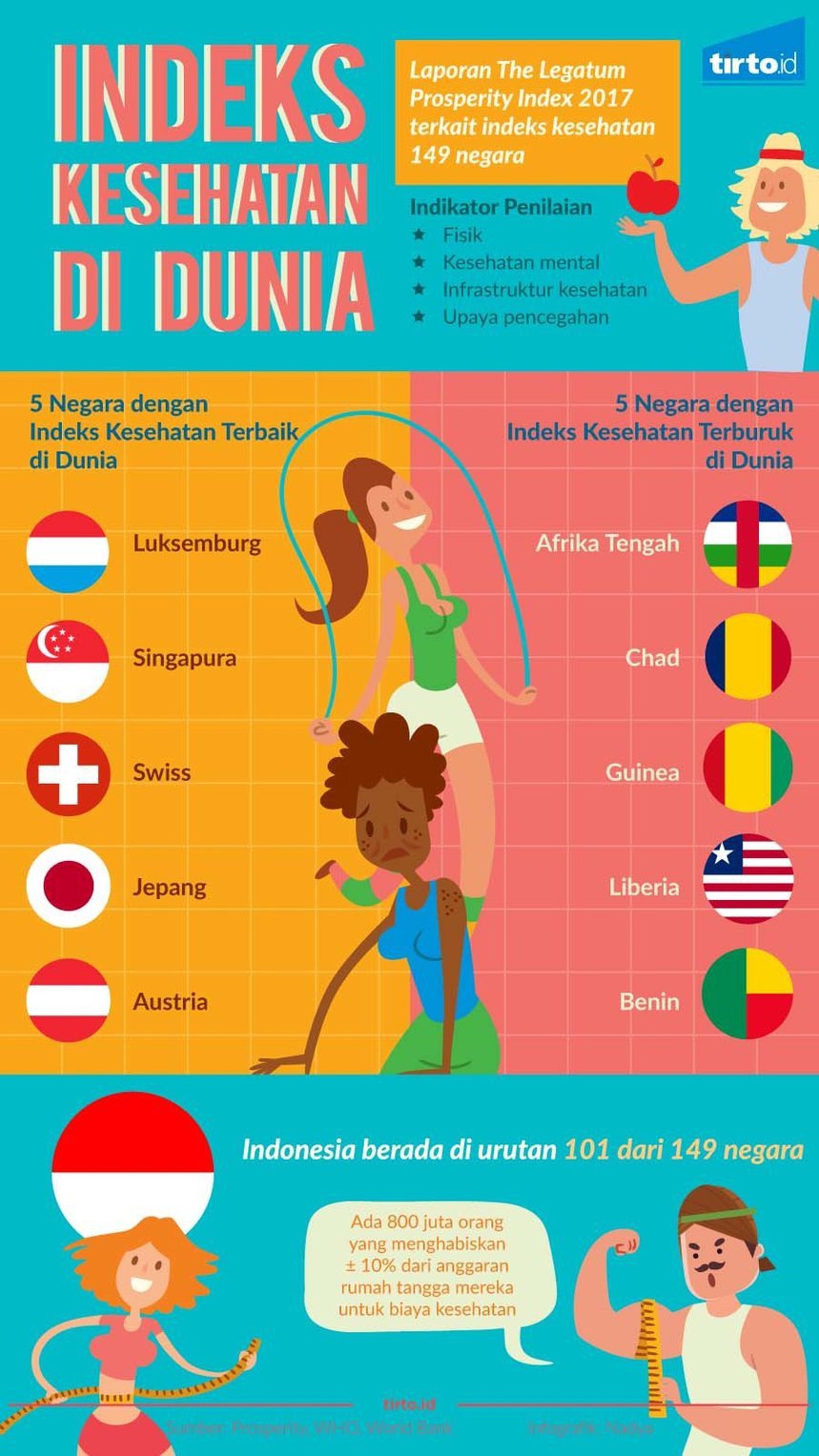
Indonesia rupanya juga berada dalam posisi yang buruk. Dalam indeks kesehatan global terakhir, Indonesia berada di posis ke 101 dari 149 negara menurut laporan The Legatum Prosperity Index 2017.

Indeks ini didasarkan pada kesehatan fisik, mental, infrastruktur kesehatan dan perawatan guna pencegahan berbagai wabah atau penyakit. Dibandingkan Singapura, misalnya, posisi Indonesia sangatlah jauh. Negara maju yang hanya seluas DKI Jakarta dengan penduduk sekitar 5 juta jiwa ini menjadi negara dengan indeks kesehatan terbaik nomor dua di dunia.

Singapura berada di bawah Luksemburg yang menjadi negara dengan indeks kesehatan terbaik di dunia. Lima negara teratas memang dipegang negara-negara maju termasuk Jepang, Swiss dan Austria. Negara-negara maju memang memiliki layanan kesehatan yang baik yang ditunjang infrastruktur memadai.

Negara-negara dunia ketiga, khususnya dari Afrika, yang sangat minim dalam layanan kesehatan yang memadai seperti Chad, Afrika Tengah, Guinea dan Liberia menempati posisi terbawah sebagai negara dengan indeks kesehatan berburuk di dunia.

Dibandingkan negara ASEAN lainnya pun posisi Indonesia masih keteteran. Thailand menempati posisi 35. Sedang Malaysia menempel Thailand di posisi 38. Indonesia bahkan kalah dari Vietnam yang berada di posisi 69 atau Laos di posisi 94.

Malaysia bahkan punya pencapain lain yang sangat menarik. Dalam 10 tahun terakhir pemerintah setempat gencar melakukan perbaikan sistem kesehatan dengan biaya murah. Tidak heran jika
berbagai layanan kesehatan seperti rumah sakit di Malaysia pun mendapat akreditasi tinggi.

Situasi itulah yang membuat Malaysia bahkan berani membangun wisata medis bagi turis atau pasien luar negeri. Hal itu terjadi karena layanan kesehatan di negara ini dinilai cukup memadai dan juga memiliki harga yang relatif terjangkau.

Pada 2011, misalnya, sekitar 643 ribu turis asing datang mengunjungi Malaysia untuk memperoleh layanan kesehatan. Jumlah itu semakin melonjak pada 2016 yang bahkan mencapai 921 ribu.

Indonesia masih memiliki banyak pekerjaan rumah pada sektor kesehatan. Misalnya, dari segi pencegahan, masih banyak warga yang kurang sadar melakukan imunisasi. Termasuk kesadaran menjaga lingkungan agar terhindar dari berbagai penyakit.

Hingga kini, 120 juta warga masih hidup dalam lingkungan dengan sanitasi yang buruk. Setiap tahun bencana asap mengancam saluran pernafasan warga di Sumatera dan Kalimantan. Mutu air sungai di Indonesia termasuk buruk karena 52 sungai berstatus tercemar berat.

Dari sisi pemerintah, sejak awal 2017, pemerintah berjanji meningkatkan layanan kesehatan dengan merilis Epidemiology Operation Center (EOC). Sistem itu akan memantau penyakit yang muncul di seluruh Indonesia selama 24 jam. Namun upaya ini ternyata belum mampu mencegah dua kematian karena difteri di Jakarta.

Sedangkan dari sisi pengobatan dan infrastruktur kesehatan, masih banyak wilayah terpencil di yang masih sulit untuk mengakses layanan medis. Bahkan wilayah yang sudah memiliki layanan medis lengkap pun, belum tentu mendapatkan layanan kesehatan karena biaya yang mahal. Meski kini pemerintah sudah menerapkan kartu Indonesia Sehat, termasuk adanya BPJS, namun rupanya hal itu belum cukup mengangkat indeks kesehatan Indonesia di tingkat global.

https://tirto.id/


World Health Organisation (WHO) with Mekong countries call for accelerated action to eliminate malaria before 2030

Representatives from Cambodia, China, the Lao People’s Democratic Republic, Myanmar, Thailand and Viet Nam today called for accelerated action to eliminate malaria in the Greater Mekong Subregion (GMS) by the year 2030. The call comes amid concern over resistance of malaria parasites to antimalarial drugs, including artemisinin—the core compound of the best available antimalarial medicines. To date, resistance has been detected in five of the six GMS countries. The best way to address the threat posed by drug resistance is to eliminate malaria altogether from the countries of the Mekong.

At a high-level meeting convened by the Ministry of Health and Sports of Myanmar in collaboration with the World Health Organization (WHO) and the Asia Pacific Leaders Malaria Alliance (APLMA), representatives from the six GMS countries stressed that eliminating malaria in the Subregion requires urgent and coordinated action, with support from implementing agencies, funders and other partners.

Ministers from the six countries pledged to:

ensure activities to eliminate malaria in the subregion are fully funded, including with more domestic funds;
improve cross-border collaboration and establish an independent oversight body, for which WHO will act as the secretariat;
strengthen systems for the identification and timely reporting of malaria infections, including drug-resistant forms;
provide the best possible prevention, diagnosis and care for all people at risk of malaria, including free services for ethnic minorities and mobile and migrant populations, as part of universal health coverage;
ensure available antimalarial medicines are safe and effective for use;
bring all concerned sectors together to translate policies into time-bound and results-oriented actions; and
engage communities in malaria elimination using innovative communication tools.
Countries requested support from WHO to achieve their malaria elimination goals.

“Malaria is a disease that we can—and must—eliminate from the Greater Mekong Subregion. The drive to achieve this goal by 2030 demonstrates the joint commitment of health leaders from across the subregion to secure the health and well-being of vulnerable populations and ensure no one is left behind,” said Dr Poonam Khetrapal Singh, WHO Regional Director for South-East Asia.

“The malaria parasite doesn’t need a passport or a visa to cross borders. You must work more closely together as one region, with one strategy to drive elimination. Accelerating malaria elimination in the Greater Mekong will not only improve lives today. It will also free future generations from the plague of malaria, and set an example for the rest of the world,” said Dr Shin Young-soo, WHO Regional Director for the Western Pacific.

WHO helps governments achieve malaria elimination by:

setting and disseminating guidance and policies on malaria control and elimination;
supporting countries as they adapt, adopt and implement WHO global norms and standards for malaria control and elimination;
assisting countries in the implementation of national malaria strategic plans;
helping countries develop robust malaria surveillance systems; and
responding to requests from countries to address threats, operational emergencies and bottleneck issues.
Recent efforts to fight malaria in the GMS have yielded impressive results. According to the latest WHO estimates, malaria cases in the six countries fell by an estimated 74% between 2012 and 2016. Deaths due to malaria fell by 91% over the same period.

This progress was made possible through greater access to effective malaria control tools, particularly artemisinin-based combination therapies for malaria treatment, rapid diagnostic tests, and insecticide-treated nets. Since 2012, targeted provision of these tools to vulnerable populations has increased substantially across the subregion, leading to acceleration in the pace of progress. Resistance to antimalarial drugs, unless addressed with urgency, could undermine these gains.

Malaria is a life-threatening disease caused by Plasmodium parasites that are transmitted to people through the bites of infected female Anopheles mosquitoes. WHO-recommended malaria control tools include: long-lasting insecticidal bed-nets, spraying inside walls of dwellings with insecticides, preventive treatment for infants and during pregnancy, prompt diagnostic testing, and treatment of confirmed cases with effective anti-malarial medicines.

http://www.thehealthsite.com/


Cakupan Kesehatan Semesta

UNIVERSAL Health Coverage (UHC) atau cakupan kesehatan semesta, merupakan target Pemerintah Indonesia untuk mencakup seluruh penduduk Indonesia dalam program Jaminan Kesehatan Nasional (JKN). Menurut Peta Jalan Kesehatan Nasional, UHC ditargetkan tahun 2019 atau satu tahun dari sekarang. Kepesertaan JKN sendiri sampai 1 November 2017 tercatat mencapai 183.579.086. Jika pada saat yang sama penduduk Indonesia ada 260 juta penduduk, maka masih lebih dari 75 juta penduduk Indonesia yang karena berbagai alasan belum menjadi anggota.

Berbagai kendala sudah banyak dikemukan di media. Mulai dari besaran iuran, kesulitan BPJS-Kesehatan dalam mendorong kepesertaan pekerja sektor informal dan kelompok muda, fasilitas kesehatan yang belum merata (sehingga peserta kesulitan mengakses pelayanan kesehatan). Hingga pelayanan kesehatan yang belum sesuai harapan membuat sebagian masyarakat memilih tidak menjadi peserta JKN. Akan tetapi jika diperhatikan lebih lanjut kendala ini – terutama keengganan sebagian masyarakat untuk menjadi peserta – salah satunya dapat dipahami dari kondisi sosio-historis masyarakat.

Sakit itu Takdir

Satu anekdot yang sering kita dengar menyebutkan jika keengganan sebagian masyarakat Indonesia menjadi peserta JKN dikarenakan kepercayaan yang sangat dalam bahwa sakit sudah ditakdirkan Tuhan. Meskipun anekdot ini tidak sepenuhnya benar akan tetapi sifat fatalis masyarakat ada kalanya mempengaruhi pengambilan keputusan. Perencanaan terhadap sesuatu yang belum pasti dianggap nggege mangsa dan salahsalah menjadi sebuah ‘doa’ meminta diberi sakit. Kondisi inilah – salah satu faktor – yang menyebabkan sebagian masyarakat baru mendaftar menjadi peserta ketika dirinya atau ada anggota keluarga yang sakit.

Dalam beberapa kajian yang dilakukan KPMAK sikap fatalis memang bisa dirasakan tapi tidak terlihat dominan. Pada umumnya masyarakat, terutama di perkotaan, sudah memahami pentingnya jaminan kesehatan. Akan tetapi keputusan untuk menjadi peserta tidak selalu berbanding lurus dengan pemahaman masyarakat tersebut. Ada berbagai faktor selain pemahaman terhadap jaminan yang mempengaruhi masyarakat untuk menjadi anggota. Faktor usia misalnya, sebagian masyarakat memilih untuk tidak menjadi peserta karena merasa sehat dan masih muda. Sehingga untuk saat ini belum merasa memerlukan jaminan kesehatan. Sebagian yang lain beralasan pengalaman teman, tetangga, atau saudara yang kurang baik membuat mereka enggan untuk mendaftar. Sedangkan di pedesaan faktor kurangnya pemahaman terhadap pentingnya jaminan kesehatan, cara mendaftar, dan tempat mendaftar masih sangat kurang.

Peningkatan Kepesertaan

Untuk mewujudkan cakupan kesehatan semesta, BPJS Kesehatan sebagai lembaga penyelenggara Jaminan Kesehatan tidak bisa bekerja sendiri. Dalam hal peningkatan pemahaman masyarakat di daerah pedesaan, BPJS-Kesehatan perlu melibatkan pemerintah daerah termasuk dalam hal ini pemerintah desa, lembaga adat, keagamaan, dan sejenisnya. Selain itu isi program sosialisasi harus fokus pada hak, kewajiban, manfaat dan prosedur dengan menyesuaikan kondisi sosial budaya setempat. Tidak lagi sekadar memperkenalkan BPJS-Kesehatan.

Khusus untuk kelompok usia muda, BPJS-Kesehatan perlu mangadopsi strategi pemasaran asuransi komersial untuk menarik minat kelompok ini, misalnya dengan mengintensifkan sesi konsultasi tatap muka. Meskipun informasi JKN bisa diakses di internet akan tetapi interaksi secara langsung sangat diperlukan. Karena masing-masing individu mempunyai kebutuhan yang berbeda-beda.

Satu catatan dari kajian yang dilakukan KPMAK adalah efektifnya gethok tular dalam menyampaikan informasi di masyarakat. Pelayanan yang kurang menyenangkan di rumah sakit dengan cepat menyebar dan mempengaruhi persepsi masyarakat terhadap program JKN. Untuk itu penguatan kompetensi dokter – tidak hanya dalam aspek klinis tapi juga teknik berkomunikasi – baik di puskesmas maupun rumah sakit sangat diperlukan selain pemenuhan kebutuhan sarana prasarana dan obat-obatan. Tanpa adanya usaha yang extra ordinary tampaknya cakupan kesehatan semesta hanya sebatas angan-angan saja.

http://krjogja.com/


World Health Organization: Malaria treatment stalls as funding flatlines

The global fight against malaria is grinding to a halt, the World Health Organization warned on Wednesday, amid flat-lining funding and political complacency.

Malaria infected an estimated 216 million people last year — about 5 million more than in 2015 — potentially reversing a six-year trend of decreasing infection cases. The majority of the 440,000 lives claimed by the mosquito-borne disease were young children in sub-Saharan Africa.

WHO Director General Tedros Adhanom Ghebreyesus said “progress appears to have stalled” in the fight against the tropical disease.

“Although there are some bright spots in the data, the overall decline in the global malaria burden has unquestionably levelled off,” Ghebreyesus said. “And, in some countries and regions, we are beginning to see reversals in the gains achieved.”

Fall in funding

Experts fear financial shortfalls and government complacency have thrown progress off track.

“At the current level of funding and coverage of current tools, we have reached the limits of what can be achieved in the fight against the disease,” said Abdisalan Noor, lead author of the WHO’s annual malaria report.

Investment into malaria prevention — a third of which came from the US last year — has leveled off since 2010. Analysis by the WHO found that funding in countries with a high risk of malaria had dropped to an average of less than two dollars per person per year.

The WHO says a minimum annual investment of $6.5 billion (€5.5 billion) is required to meet its ambitious 2030 targets.

Funding in 2016 stood at just $2.7 billion.

Change in fortunes

The long-term global decline in malaria-related deaths has helped cut child mortality, driving a sharp increase in global life expectancy.

The WHO has repeatedly made announcement on “the massive roll-out of effective disease-cutting tools” and “impressive reductions in cases and deaths.”
Mosquito nets soaked in insecticide — mostly delivered through mass distribution campaigns — are the primary method of protection. But in sub-Saharan Africa fewer than half of households have sufficient access to them.

“If we continue with a business-as-usual approach — employing the same level of resources and the same interventions — we will face near-certain increases in malaria cases and deaths,” Ghebreyesus said.

Uneven coverage

Some 80 percent of malaria deaths take place in just 15 countries — 14 sub-Saharan African nations and India.

Emergency work is underway in Nigeria, South Sudan, Venezuela and Yemen, where ongoing humanitarian crises pose further public health risks.
Several countries in the Middle East and central Asia have been certified as malaria-free in the last decade, including Morocco, Armenia and Turkmenistan. Last year, Kyrgyzstan and Sri Lanka joined their ranks, having gone three years without recording an indigenous case of malaria.

“We are up against a tough adversary,” Ghebreyesus said. “But I am also convinced that this is a winnable battle.”

http://www.dw.com/


Babak Baru Kesehatan Tradisional Indonesia

Jakarta, Gatra.Com – 15 Organisasi kesehatan tradisional Indonesia mendeklarasikan pendirian Perkumpulan Induk Organisasi Kesehatan Tradisional Indonesia (PIKTI). Babak baru pengembangan kesehatan tradisional.

Wadah organisasi yang baru terbentuk ini telah menunjuk Dr. dr. Ekawahyu Kasih sebagai Ketua Umum PIKTI yang terpilih secara aklamasi. Menurutnya, organisasi baru ini bertujuan menyokong Kementerian Kesehatan khususnya Direktorat Kesehatan Tradisional Indonesia dalam mengembangkan kesehatan tradisioal baik empiris maupun komplementer.

Mulai dari upaya pencegahan, pengobatan, rehabilitasi yang membutuhkan biaya negara yang sangat besar untuk menjamin kesehatan masyarakat di Indonesia.

“PIKTI bertekad untuk menjadi mitra Kementerian Kesehatan dalam memberikan masukan dan saran yang konstruktif agar seluruh kebijakan dan regulasi yang akan dikeluarkan pemerintah yang berkaitan dengan kesehatan tradisional Indonesia dapat menyelesaikan setiap akar permasalahan yang sebenarnya,” jelasnya.

Untuk itu, ia mengajak seluruh organisasi kesehatan tradisional Indonesia yang belum menjadi anggota PIKTI untuk dapat bergabung menjadi anggota PIKTI sebagai upaya menyatukan seluruh potensi sumber daya tradisional Indonesia dalam rangka menghadapi berbagai tantangan baik ditingkat Nasional, Regional maupun Internasional.

“Organisasi PIKTI juga mendorong berdirinya Perguruan Tinggi dengan program studi Kesehatan Tradisional Indonesia untuk menambah kuantitas dan kualitas pelaku kesehatan tradisional Indonesia,”katanya.

Organisasi pendiri PIKTI :

  1. Perkumpulan Terapis Kesehatan Holistik Indonesia
  2. Perkumpulan Para Pemijat Penyehatan Indonesia
  3. Perkumpulan Praktisi Ilmu Kesehatan Ruang Tubuh Indonesia
  4. Andalan Penyembuh Alternatif Indonesia
  5. Perkumpulan Asosiasi Spa Terapis Indonesia
  6. Persaudaraan Pelaku & Pemerhati Pijat Refleksi Indonesia
  7. Persaudaraan Pelaku dan Pemerhati Akunpuntur Indonesia
  8. Perkumpulan Tuina Indonesia
  9. Pekumpulan Naturpatis Indonesia
  10. Asosiasi Pengobatan Tradisional Ramuan Indonesia
  11. Asosiasi Medikal Hipnoterapi Indonesia
  12. LSK – Pijat Akupresur Indonesia
  13. LSK – Sinshe TCM Indonesia / STAB Nalanda
  14. Yayasan Keluarga 70
  15. LSK Pijat Tradisional Indonesia


sumber:  https://www.gatra.com/


Menkes: Total Pembelian Obat e-Katalog 2017 Capai Rp 18 Triliun

Menteri Kesehatan (Menkes) Nila Farid Moeloek menyatakan bahwa transaksi pengadaan obat lewat sistem elektronik katalog atau e-katalog pada tahun 2017 sebesar Rp18 triliun.

“Pembelian e-katalog sudah tembus Rp18 triliun,” kata Nila di Bekasi, Kamis (23/11/2017).

Menurut Menkes, transaksi e-katalog adalah sistem yang bagus karena terbuka untuk umum. Ia pun menyatakan jenis obat yang laris melalui sistem itu adalah obat generik karena harganya yang lebih murah dari obat paten.

Ia juga yakin pemakai layanan transaksi e-katalog akan meluas karena Indonesia merupakan populasi penduduk yang tergolong besar.

“Untuk farmasi kita mendorong dapat mandiri dan membuat obat-obatan yang layak dipakai masyarakat. Obat generik pun memiliki kasiat yang sama dengan obat paten,” kata Nila.

Ia juga mendorong agar pelaksanaan Pengadaan Obat Dengan Prosedur e-Purchasing Berdasarkan e-katalog dapat meningkatkan efisiensi, efektivitas dan transparansi dalam proses pengadaan obat.

Selain itu, Nila juga menyatakan bahwa sistem itu bisa mengurangi adanya potensi korupsi, kolusi dan nepotisme (KKN) di kalangan profesi kedokteran maupun manajemen rumah sakit.

“Suplier saat ini sedang kita dorong lewat e-katalog berikut pencantuman harganya, sehingga lebih banyak obat generik dengan harga lebih murah,” katanya.

Ia juga menyatakan bahwa sistem itu bisa menutup celah oknum dokter yang sebelumnya bisa ‘memainkan’ harga pasaran obat karena harga yang tercantum dalam e-katalog bisa diakses masyarakat luas dan terawasi.

“Dokter sudah tidak mungkin lagi melakukan gratifikasi. Sistem ini bagus karena rumah sakit dapat memantau fluktuasi harga pasaran yang terbuka secara umum,” kata Menkes Nila.

https://tirto.id/


Hot topics in public health go global in Berlin at the World Health Summit

The burning issue at this year’s World Health Summit in Berlin was health security. At this 8th WHS it was clearer than ever that the walls between the traditional disciplines of ‘global health’ and (European) ‘public health’ are rapidly coming down, with health threats anywhere in the world becoming a domestic challenge as well as an international development issue. The topics driving the agenda in Berlin are increasingly preoccupying European Heads of State as well as their G7 and G20 counterparts. It is a welcome signal that the patrons of the WHS, Chancellor Merkel and European Commission President Juncker, are joined by France’s President Macron. Nevertheless, in a blistering keynote speech MSF International President Joanne Liu challenged the mostly-European audience to protect health wherever and whenever threats arise and not only when they reach our shores.

Antimicrobial resistance (AMR) emerged as one of the principal topics under discussion at the 2017 World Health Summit in Berlin, with a number of sessions looking at it from a global, “One Health” perspective and in the broader context of international policy action in support of achieving the Sustainable Development Goals.

Ahead of the WHS, the UK government, with the Wellcome Trust and the governments of Ghana and Thailand, organised another event in Berlin hosted by Professor Dame Sally Davies. EPHA Secretary General Nina Renshaw was invited to present and spoke about the importance of binding measures to tackle pollution in the antibiotic supply chain, as a major accelerator of resistant bacteria in the local environment of pharmaceutical factories which can then spread rapidly.

At the WHS session on AMR, Dr Rüdiger Krech (WHO), underlined the global scope of the AMR problem, recalling that gonorrhoea is becoming increasingly resistant to antibiotics, while also mentioning multi-drug resistant TB, E.Coli and hospital infections including MRSA.

EPHA’s points appear to be echoed by attendees at both events. Notably, Thomas Cueni (Director General, International Federation of Pharmaceutical Manufacturers & Associations) recognised the problem of environmental spill-over in e.g. India in the supply chain of cheaply produced generic drugs, with public procurement (e.g. certified suppliers) and consumer choice as powerful tools that could be exploited. He also stated that if voluntary initiatives don’t work, regulatory approaches could be considered, with some companies willing to share data with WHO.

Jeremy Knox of the Wellcome Trust emphasised that the evidence base regarding behaviour change is not as developed as it should be. He pointed out that Wellcome is developing a new policy and advocacy stream on AMR working in collaboration with civil society, while at the same time making a major investment in the CARB-X Global Partnership.

Discussion turned to the question of developing and managing antimicrobials effectively as a “global public good” and the flawed business model for antibiotics, with companies not following rhetoric with action, according to Dr Krech, keen on investing in more profitable medicines and on avoiding any regulation. In turn, Cueni explained some key industry obstacles, noting high risk of failure in the development process. He argued for a globally funded model but was sceptical that this would happen anytime soon. Mr Knox stated that it was high time that governments and companies began to experiment with available innovation models, the best of which combine push and pull incentives.

Another problem highlighted by participants was that antibiotics are cheaper than diagnostics, which means it is easier to omit testing before prescribing them.

Representing the German Federal Ministry of Health, Karin Knufmann-Happe also mentioned the environmental dimension of AMR – specifically, antibiotic waste and residues in water – as a key element of Germany’s inter-sectoral national strategy (2015), designed to be closely aligned with the WHO Global Action Plan. She revealed that Germany’s efforts to influence the G7 and G20 agendas is motivated by the recognition that some issues cannot be tackled at the national level alone, and that tackling AMR also involves health systems strengthening. A new global AMR R&D hub is planned to be established in Germany to pursue a long-term vision.

Vaccination also featured strongly at the WHS, including as a measure to reduce antibiotic use, especially reflecting growing concerns over vaccine hesitancy and recent vaccine-preventable disease outbreaks, including measles in Europe.

https://epha.org/