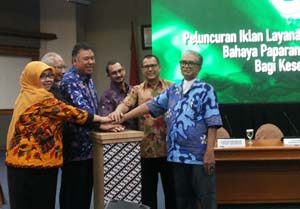
Kemenkes Luncurkan Iklan Bahaya Menjadi Perokok Pasif

22meikki

22meikkiKementerian Kesehatan (Kemenkes) meluncurkan iklan kampanye anti rokok versi baru yang mengingatkan para perokok pasif akan bahaya asap rokok. Iklan tersebut menampilkan Ike, perempuan usia 37 tahun yang terkena kanker pita suara.

Ike terpapar asap rokok di tempat kerja,sebuah restoran yang dipenuhi asap rokok terus menerus selama 10 tahun. Suaminya bukan perokok. Ike kini berkomunikasi lewat kertas dan pena, karena pita suaranya hilang lantaran harus dibuang akibat kanker.

Sekjen Kemenkes Untung Suseno Sutarjo dalam peluncuran iklan layanan masyarakat bertajuk “Berhentilah Merokok, Asapmu Membunuh Orang-Orang di Sekitarmu”, di Jakarta, Jumat (22/5) mengatakan, kampanye itu dilakukan untuk membangkitkan lagi kesadaran masyarakat akan bahaya menjadi perokok pasif. Mengingat, jumlah perokok di Indonesia sudah mencapai 53,7 juta orang.

“Bukan saja diingatkan, tapi masyarakat harus berani menegur orang yang merokok di tempat-tempat yang ada larangannya,” ucap Untung Suseno menegaskan.

Mengutip hasil riset kesehatan dasar (Rikesdas) 2010, ada sekitar 95 juta orang di Indonesia terpapar asap rokok, termasuk di dalamnya 40,3 juta anak Indonesia berusia 0 – 14 tahun sebagai perokok pasif. Paparan asap rokok memiliki dampak negatif yang sama bahayanya dengan perokok aktif.

Dalam kutipan buku The Tobacco Atlas yang diterbitkan American Cancer Society dan World Lung Foundation dinyatakan pula paparan asap rokok meningkatkan risiko terkena kanker paru-paru sebesar 30 persen dan penyakit jantung koroner sebanyak 25 persen.

“Hasil penelitian Global Adult Tobacco Survey (GATS) periode 2008 – 2013 menunjukkan data persentase prevalensi paparan asap rokok terhadap orang dewasa di Indonesia. GATS mencatat lebih dari 85 persen orang dewasa Indonesia terkena paparan asap rokok di rumah, lebih dari 78 persen di tempat makan, dan 50 persen di tempat kerja,” katanya.

Terkait kebijakan anti rokok, Untung Suseno mengatakan, Indonesia telah menyusun berbagai aturan yang mengatur perlindungan masyarakat dari bahaya paparan asap rokok. Salah satunya lewar penerapan Kawasan Tanpa Rokok (KTR) di berbagai tempat umum maupun tempat kerja, terutama di lingkungan sekolah dan rumah sakit. (TW)

{jcomments on}

Indonesia Prioritaskan Layanan Kesehatan Primer

Indonesia menekankan pentingnya pelayanan kesehatan primer dan jaminan kesehatan guna mewujudkan sistem kesehatan yang tangguh dan kuat. “Saat ini Jaminan Kesehatan Nasional (JKN) telah melayani 143 juta orang guna mencapai universal health coverage tahun 2019,” kata Menteri Kesehatan Prof. Dr. dr. Nila F. Moeloek.

Pernyataan Nina itu disampaikan saat sesi Pleno Sidang World Health Assembly (WHA) ke-68 pada 19 Mei 2015, di Kantor PBB Jenewa, Swiss. Sidang yang berlangsung pada 18 – 26 Mei 2015 mengambil tema “building resilient health system” khususnya terkait wabah Ebola di kawasan Afrika Barat.

Nina menjelaskan untuk mencapai Indonesia Sehat pada 2019, saat ini sedang dilakukan transformasi dan reformasi pelayanan kesehatan primer. Selain itu penguatan sistem kesehatan melalui sistem rujukan yang efektif, layanan kesehatan yang kuat di rumah sakit dan penelitian visioner untuk ilmu kedokteran guna mewujudkan pelayanan kesehatan yang adil dan inklusif bagi semua masyarakat.

Dalam rilis yang dikirim Minister Counsellor (Politics) Permanent Mission Perutusan Tetap RI pada PBB di Jenewa, Acep Somantri, Indonesia menyampaikan komitmen untuk terus implementasikan International Health Regulation sebagai panduan utama bagi seluruh anggota PBB dalam meningkatkan kapasitas nasionalnya menghadapi berbagai ancaman kesehatan global.

Menurut Acep Somantri, Menteri Nina juga menekankan beberapa isu lain, yaitu pentingnya masyarakat internasional untuk terus memberikan dukungan terhadap kampanye global untuk memberantas polio dengan mempertimbangkan kondisi nasional masing-masing negara. Lalu mendorong implementasi penuh Pandemic Influenza Preparedness Framework yang merupakan salah satu capaian terbesar masyarakat internasional pasca keberhasilan penanganan kasus avian influenza (flu burung).

Delegasi Indonesia pada Sidang WHA tahun 2015 dipimpin Menteri Nina. Anggotanya para pejabat dari Kementrian Kesehatan, Kementrian Luar Negeri, Badan POM, serta Perutusan Tetap RI pada PBB di Jenewa. Selain memberikan pernyataan pada sesi pleno, Menkes Nina juga menyampaikan sambutan pada saat diselenggarakannya pertemuan ke-8 para Menteri Kesehatan negara-negara Gerakan Non-Blok.

sumber: http://nasional.tempo.co/


The WHO is the only international organization that has universal political legitimacy on global health issues

German Chancellor Angela Merkel addressed delegates on the first morning of the Sixty-eighth World Health Assembly, Tuesday, the 19th of May. “The WHO is the only international organization that has universal political legitimacy on global health issues,” she said.

Chancellor Merkel called for a new plan to deal with “catastrophes” like the recent outbreak of Ebola that wreaked havoc in Africa. The outbreak highlighted the critical need for urgent, collaborative action in emergencies, and the importance of having efficient structures in place to ensure timely and accurate responses to healthcare crises. Chancellor Merkel paid tribute to all those working to safeguard human health worldwide, urging them to “work together”.

She pledged that under Germany’s presidency, the G7 would focus on fighting antimicrobial resistance and neglected tropical diseases. She emphasized the need for all countries to have strong health systems and highlighted the key role of health in sustainable development.

NEW PROGRAMME FOR HEALTH EMERGENCIES

In the afternoon, WHO Director-General Dr Margaret Chan outlined her plans to create a single new WHO programme for health emergencies, uniting outbreak and emergency resources across the 3 levels of the Organization. “I have heard what the world expects from WHO,” said Dr Chan. “And we will deliver.”

The new programme will be accountable to the Director-General, and will have its own business rules and operational platforms. It will have clear performance metrics, built on partnerships with other responders. It will set up a new global health emergency workforce, as well as strengthening its own core and surge capacity of trained emergency response staff. The Organization is calling for a new USD100 million contingency fund. The Director-General plans to complete these changes by the end of the year.

source: http://www.neurope.eu/article


WHO siapkan dana Rp1,3 triliun untuk Ebola

Organisasi kesehatan dunia, WHO, mencanangkan dana darurat US$100 juta (Rp1,3 trilyun) untuk menanggulangi wabah Ebola.

Direktur Jendral WHO, Margaret Chan, menyatakan organisasinya kewalahan menghadapi penyebaran penyakit ini di Afrika Barat. Ia mengatakan kebutuhan penanganannya sepuluh kali lipat lebih besar daripada yang diduga.

Wabah penyakit ini dilaporkan terjadi bulan Maret 2014, dan telah mengambil korban sebanyak 11.000 jiwa. Selama ini, Chan dan WHO diritik banyak pihak karena kelambatan mereka dalam menangani wabah ini.

“Dengan dukungan negara anggota, saya mencanangkan dana darurat US$100 juta, bersumber dari sumbangan sukarela tak mengikat, untuk menjamin bahwa kami memiliki sumber daya yang dibutuhkan untuk segera menyusun tanggapan awal,” kata Chan dalam pertemuan tahunan WHO.
Chan juga sedang menyusun sebuah program ‘terpadu’ untuk menangani darurat kesehatan ini.

Bebas Ebola

Sebelumnya, Kanselir Jerman, Angela Merkel, menyerukan dalam sesi pembukaan pertemuan ini, bahwa WHO wajib merampingkan organisasinya untuk menanggapi segera krisis semacam Ebola.

“Saya yakin jika kita bertindak lebih cepat dan punya struktur komando yang jelas, kita akan lebih siap menghadapi krisis seperti Ebola, apabila terjadi lagi di masa depan.” katanya.

Wabah Ebola merupakan yang paling mematikan sejak penyakit itu ‘ditemukan’ pada tahun 1976. Kasus pertama terjadi di Guinea tenggara awal tahun lalu dan menyebar ke Liberia, Sierra Leone, Nigeria dan Mali.

Beberapa negara, termasuk Amerika Serikat, Spanyol, Jerman, Norwegia, Prancis, Italia, Swiss dan Inggris Raya, merawat pasien yang terkena virus ini di Afrika Barat.

Belakangan, Liberia menjadi negara pertama -dari tiga negara yang paling terpengaruh- yang sudah dinyatakan bebas virus, setelah selama 42 hari tidak ditemukan kasus baru.

sumber: http://www.bbc.co.uk/

Sixty-eighth World Health Assembly opens in Geneva

18 MAY 2015 ¦ GENEVA – Angela Merkel, Chancellor of the Federal Republic of Germany addressed delegates on the first morning of the Sixty-eighth World Health Assembly. “The WHO is the only international organization that has universal political legitimacy on global health issues,” she said.

Chancellor Merkel called for a new plan to deal with “catastrophes” like the recent Ebola outbreak. The outbreak highlighted the critical need for urgent, collaborative action in emergencies, and the importance of having efficient structures in place. Chancellor Merkel paid tribute to all those working to safeguard human health worldwide, urging them to “work together”.

She pledged that under Germany’s presidency, the G7 would focus on fighting antimicrobial resistance and neglected tropical diseases. She emphasized the need for all countries to have strong health systems and highlighted the key role of health in sustainable development.

New programme for health emergencies

In the afternoon, WHO Director-General Dr Margaret Chan outlined her plans to create a single new WHO programme for health emergencies, uniting outbreak and emergency resources across the 3 levels of the Organization. “I have heard what the world expects from WHO,” said Dr Chan. “And we will deliver.”

The new programme will be accountable to the Director-General, and will have its own business rules and operational platforms. It will have clear performance metrics, built on partnerships with other responders. It will set up a new global health emergency workforce, as well as strengthening its own core and surge capacity of trained emergency response staff. The Organization is calling for a new USD100 million contingency fund. The Director-General plans to complete these changes by the end of the year.

Dr Chan reiterated Chancellor Merkel’s points about the importance of building resilient health systems and defeating antimicrobial resistance, citing the “spectre of a post-antibiotic era in which common infections will once again kill,” and urging delegates to adopt the draft global action plan on antimicrobial resistance on this year’s Health Assembly agenda.”

She also noted the need to ensure that the International Health Regulations, the world’s legal instruments for outbreak preparedness and response, are effective. She urged delegates to ready themselves for the post-2015 development agenda and to ensure that health receives the attention, and the resources it needs: “The goals are ambitious. Financing plans must likewise be ambitious but credible.”

Dr Chan also encouraged Member States to align in preparation for the Climate Conference in Paris at the end of the year, pointing out that health had remained on the side lines of this critical issue for too long.

New President of the World Health Assembly

Earlier in the day, the Health Assembly elected Dr Shri Jagat Prakash Nadda of India as its new President. Five vice-presidents were also appointed from Afghanistan, Barbados, China, San Marino, and Senegal, representing their respective regions. Addressing the Health Assembly, Dr Nadda announced a number of contributions to WHO from India, including a donation to the WHO contingency fund.

Topics covered during the 68th WHA

More than 3000 delegates from WHO’s 194 Member States – including a large proportion of the world’s health ministers – are expected to attend the Health Assembly, which ends on 26 May. They will discuss resolutions and decision points on antimicrobial resistance, Ebola, epilepsy, the International Health Regulations, malaria, nutrition, polio, public health, innovation, and intellectual property, substandard/spurious/falsely-labelled/falsified/counterfeit medical products, surgical care and anaesthesia.

Delegates will be asked to approve the Organization’s planned budget and programme of work for 2016-2017. They will also review progress reports on a wide range of issues such as adolescent health, immunization, noncommunicable diseases, women and health, and WHO’s response in severe, large-scale emergencies.

A series of daily technical briefings started today with a discussion about health in the post-2015 sustainable development goals. Subsequent sessions will address the Ebola outbreak, climate and health, preparations for the third UN High-level meeting on noncommunicable diseases in 2018, cancer prevention and control, and the development of global health sector strategies for HIV, viral hepatitis and sexually transmitted infections.

Notes to editors:

The World Health Assembly is attended by delegates from WHO Member States as well as representatives from many agencies, organizations, foundations and other groups that contribute to improving public health. Member States approve resolutions in committee before formally adopting them in the plenary session at the end of the Health Assembly.

source: http://www.who.int/



Indonesia Masih Tunda Penggunaan Vaksin Polio Injeksi

Pertemuan seluruh negara anggota Organisasi Kesehatan Dunia (WHO) dalam Sidang World Health Assembly (WHA) ke-68 mulai dibuka hari ini, Senin (18/5) di Jenewa, Swiss. Menjelang sidang ini, sebelas negara anggota WHO khusus South East Asia Region (SEAR), seperti Bangladesh, Butan, PDR Korea, India, Indonesia, Maldives, Myanmar, Nepal, Srilanka, Thailand, dan Timor Leste bertemu untuk membahas isu-isu tertentu dalam pertemuan akbar tersebut.

Bagi Indonesia, tema tentang rencana penerapan vaccine polio injection atau Injection Polio Vacine (IPV) menjadi perhatian khusus. Di negara maju, penerapan IPV sudah dilakukan. Sedangkan Indonesia bermaksud masih menunda penerapan penggunaan IPV dikarenakan alasan geografis yang perlu disiapkan secara matang.

“Kami berharap agar dalam pembahasan mengenai polio di sidang WHA ke-68 akan mendapat dukungan dari negara-negara anggota SEAR,” kata Dirjen Pengendalian Penyakit dan Penyehatan Lingkungan (P2PL) Kementerian Kesehatan (Kemkes) dalam siaran pers di Jakarta, Senin (18/5).

Sementara resolusi WHA sebagai forum tertinggi WHO agar di 2015 ini tidak ada lagi negara yang menggunakan vaksin polio oral, melainkan suntikan (injeksi). Alasan dikeluarkannya resolusi WHA untuk menggunakan vaksin injeksi agar eradikasi polio secara global lebih optimal. Sementara penggunaan vaksin oral dikhawatirkan bisa berpindah dan menularkan lagi melalui limbah manusia.

Tahun lalu, di bawah kepemimpinan Menteri Kesehatan Nafsiah Mboi, Kemkes memutuskan untuk beralih dari penggunaan vaksin polio dalam bentuk oral ke injeksi secara bertahap. Mulai tahun 2015, dari empat kali pemberian vaksin, 3 di antaranya dalam bentuk oral, dan 1 lagi injeksi.

Ini dilakukan sampai PT Bio Farma mampu memproduksi injeksi sendiri. Kemkes targetkan 2018 baru Indonesia menggunakan vaksin polio injeksi secara penuh, dan dilakukan dalam tiga tahun berturut-turut.

“Oleh karena itu Indonesia meminta dukungan dari WHO untuk memfasilitasi segera mungkin, seperti pembangunan sarana produksi, sehingga Indonesia mandiri produksi sendiri dan tidak tergantung pada impor,” kata Wakil Menteri Kesehatan kala itu, Prof Ali Ghufron Mukti.

Ghufron kala itu mengungkapkan, beralihnya penggunaan vaksin polio oral ke injeksi menjadi tantangan berat buat Indonesia. Sebab, untuk saat ini Indonesia satu-satunya negara yang mampu memproduksi vaksin polio dengan cara oral.

Melalui PT Bio Farma, produksi vaksin polio cukup besar untuk memenuhi kebutuhan dalam negeri, dan bahkan diimpor ke 118 negara. Namun, dengan adanya resolusi WHA tersebut, ekspor kemungkinan dihentikan.

Di sisi lain, pada Maret 2014 Indonesia dinyatakan wilayah bebas polio. Oleh karenanya masih dibutuhkan vaksin untuk terus mengeradikasi penyakit polio.

Itu artinya, Indonesia akan mengimpor vaksin injeksi yang membutuhkan biaya besar. Pasalnya, harga injeksi dibanding oral selisihnya 40-50 kali lipat. Untuk satu provinsi saja, yaitu Yogyakarta sebagai provinsi pilot project untuk penerapan vaksin polio suntik menghabiskan anggaran sebesar Rp 500 juta.

“Bisa dibayangkan berapa kerugian akibat berhenti ekspor, dan berapa banyak dana yang kita harus gelontorkan untuk membeli vaksin dari luar bagi seluruh provinsi ,” kata Ghufron.

Pemerintah Indonesia sendiri belum menghitung berapa besar kerugian karena berhenti mengekspor, dan besarnya anggaran yang digelontorkan untuk impor. Hingga tahun 2018 pemerintah mendapat bantuan vaksin polio suntik dari Global Alliance for Vaccines & Immunization (GAVI).

Untuk kebutuhan tahun 2015 sampai 2018, Indonesia masih sharing cost untuk pembelian injeksi dengan GAVI, dan diharapkan pada 2018, Bio Farma sudah bisa memproduksi sendiri vaksin polio injeksi.

sumber: http://www.beritasatu.com/


WHO report shows mixed results for global health goals

GENEVA, May 13 (Xinhua) — The World Health Organization (WHO) released on Wednesday its World Health Statistics 2015 report to assess the progress made towards meeting health-related objectives in 194 countries around the world.

Data on mortality and health system indicators including life expectancy, illnesses and deaths from diseases, as well as statistics on health services and financial investment, unveil a mixed picture as the 2015 UN Millennium Development Goals (MDGs) deadline approaches.

“We have seen incredible progress in the last 25 years, particularly in HIV, malaria and tuberculosis” said WHO Health Statistics and Information Systems director Ties Boerma, adding that “many issues still need to be addressed.”

WHO figures indicate that although few global targets have been met, a number of objectives show positive trends and are on track of being realized.

Regional disparities also highlight the varied situation across the world: the Americas, Europe and the Western Pacific have reported substantial progress across most health-related sectors since 1990, while the Eastern Mediterranean and Africa have reported only limited progress.

Recent development in countries such as China, which has “significantly contributed to global achievements” according to Boerma, has been decisive in improving the systemic outlook.

Figures show that China has met most of the MDG targets, including reducing the under-five mortality rate (by 76 percent), achieving a measles immunization rate among 1 year olds of 99 percent and reducing the tuberculosis mortality rate by 84 percent, amongst other achievements.

Amid a mixed global picture and despite health figures falling short of targets set in 2000, progress in global child survival is considered to be one of the greatest success stories of international development, as the mortality rate of children under five has almost halved since 1990.

Global trends of HIV, malaria and tuberculosis have also been reversed, meeting targets to turn around the epidemics by 2015 — 2.1 million HIV infections were reported in 2013, compared to 3.4 million in 2001.

Similarly, the number of malaria cases is estimated to have fallen from 227 million in 2000 to 198 million in 2013.

The global life expectancy at birth for both sexes was 71 years in 2013 (compared to 64 in 1990), the lowest being in the African Region (58) and the highest in the Region of the Americas (77)

Come September, countries will draw up new global targets to be reached by 2030, so as to finish the MDG agenda and address emerging problems such as non-communicable diseases, which account for two-thirds of global deaths, as well as other socio-environmental factors which are affecting the global population.

source: http://www.shanghaidaily.com


World Health Statistics reports on global health goals for 194 countries

13 MAY 2015 | GENEVA – 2015 is the final year for the United Nations Millennium Development Goals (MDGs) – goals set by governments in 2000 to guide global efforts to end poverty. This year’s “World Health Statistics” – published today by WHO – assesses progress towards the health-related goals in each of the 194 countries for which data are available. The results are mixed.

By the end of this year if current trends continue, the world will have met global targets for turning around the epidemics of HIV, malaria and tuberculosis and increasing access to safe drinking water. It will also have made substantial progress in reducing child undernutrition, maternal and child deaths, and increasing access to basic sanitation.

“The MDGs have been good for public health. They have focused political attention and generated badly needed funds for many important public health challenges,” says Dr Margaret Chan, Director-General of WHO. “While progress has been very encouraging, there are still wide gaps between and within countries. Today’s report underscores the need to sustain efforts to ensure the world’s most vulnerable people have access to health services.”

Child deaths halved, but won’t reach target

Progress in child survival worldwide is one of the greatest success stories of international development. Since 1990, child deaths have almost halved – falling from an estimated 90 deaths per 1000 live births to 46 deaths per 1000 live births in 2013.

Despite great advances, this is not enough to reach the goal of reducing the death rate by two-thirds. Less than one third of all countries have achieved or are on track to meet this target by the end of this year. The top killers of children aged less than 5 years are now: preterm birth complications, pneumonia, birth asphyxia and diarrhoea.

Saving more mothers

The number of women who died due to complications during pregnancy and childbirth has almost halved between 1990 and 2013. This rate of decrease won’t be enough to achieve the targeted reduction of 75% by the end of this year.

The maternal mortality ratio has fallen in every region. However, 13 countries with some of the world’s highest rates have made little progress in reducing these largely preventable deaths.

In the WHO African Region, 1 in 4 women who wants to prevent or delay childbearing does not have access to contraceptives, and only 1 in 2 women gives birth with the support of a skilled birth attendant. Less than two-thirds (64%) of women worldwide receive the recommended minimum of 4 antenatal care visits during pregnancy.

Reversing the spread of HIV

The world has begun to reverse the spread of HIV, with new infections reported in 2013 of 2.1 million people, down from 3.4 million in 2001.

The revised target of achieving universal access to treatment for HIV will be more challenging as WHO’s recommendations have resulted in much higher numbers of people needing treatment. At current trends, the world will exceed the target of placing 15 million people in low- and middle-income countries on antiretroviral therapy (ARTs) in 2015. By the end of 2013, almost 13 million people received ARTs globally. Of these, 11.7 million lived in low- and middle-income countries, representing 37% of people living with HIV in those countries.

Increasing access to safe drinking water and sanitation

While the global target for increasing access to safe drinking water was met in 2010, the WHO African and Eastern Mediterranean Regions fall far short, particularly for poor people and those living in rural areas.

The world is unlikely to meet the MDG target on access to basic sanitation. Around 1 billion people have no access to basic sanitation and are forced to defecate in open spaces such as fields and near water sources. Lack of sanitation facilities puts these people at high risk of diarrhoeal diseases (including cholera), trachoma and hepatitis.

Beyond 2015

In September, countries will decide on new and ambitious global goals for 2030 at the United Nations General Assembly in New York. In addition to finishing the MDG agenda, the post-2015 agenda needs to tackle emerging challenges including the growing impact of noncommunicable diseases, like diabetes and heart disease, and the changing social and environmental determinants that affect health.

The draft post-2015 agenda proposes 17 goals, including an overarching health goal to “ensure healthy lives and promote well-being for all at all ages”.

Key facts from World Health Statistics 2015

  • Life expectancy at birth has increased 6 years for both men and women since 1990.
  • Two-thirds of deaths worldwide are due to noncommunicable diseases.
  • In some countries, more than one-third of births are delivered by caesarean section.
  • In low- and middle-income countries, only two-thirds of pregnant women with HIV receive antiretrovirals to prevent transmission to their baby.
  • Over one-third of adult men smoke tobacco.
  • Only 1 in 3 African children with suspected pneumonia receives antibiotics.
  • 15% of women worldwide are obese.
  • The median age of people living in low-income countries is 20 years, while it is 40 years in high-income countries.
  • One quarter of men have raised blood pressure.
  • In some countries, less than 5% of total government expenditure is on health.

About WHO statistics

Published every year since 2005 by WHO, World Health Statistics is the definitive source of information on the health of the world’s people. It contains data from 194 countries on a range of mortality, disease and health system indicators including life expectancy, illnesses and deaths from key diseases, health services and treatments, financial investment in health, as well as risk factors and behaviours that affect health.

source: http://www.who.int/


InaSH: 75% Kasus Hipertensi Belum Terjangkau Pelayanan Kesehatan

Memperingati Hari Hipertensi Sedunia 2015 yang tahun ini mengambil tema “Know Your Number”, Indonesian Society of Hypertension (InaSH) akan mengadakan kegiatan seminar awam di beberapa rumah sakit di Jakarta, serta menyebarluaskan informasi kepada masyarakat untuk meningkatkan kepedulian terhadap hipertensi

Hal ini menjadi sangat penting karena hipertensi sampai saat ini masih menjadi masalah kesehatan di Indonesia dan merupakan faktor risiko utama terjadinya kerusakan organ vital. “Dari hasil Riskesdas (riset kesehatan dasar) 2007, kasus hipertensi yang sudah terdiagnosis atau yang telah minum obat hipertensi masih rendah yaitu 24,2 persen. Hal ini menunjukkan 75,8 persen kasus hipertensi di masyarakat belum terjangkau pelayanan kesehatan. Analisis lebih lanjut pun menunjukkan hanya sekitar 18 persen mempunyai tekanan darah yang terkontrol dari yang telah terdiagnosis,” ungkap Ketua InaSH dan juga dokter spesialis jantung dan pembuluh darah, Nani Hersunarti di Jakarta, Rabu (13/5).

Selain itu, hipertensi juga masih merupakan faktor risiko utama terjadinya stroke. Celakanya, hipertensi sering tanpa gejala dan hanya bisa diketahui bila dilakukan pengecekan tekanan darah. “Saat sudah timbul gejala, sebenarnya sudah mengalami kerusakan target organ dan ini sudah sangat terlambat. Kerusakan target organ otak dapat menyebabkan stroke dan gangguan kognitif ringan sampai dengan dementia vascular,” ungkap Yuda Turana, Wakil Ketua I InaSH yang juga seorang ahli syaraf.

Untuk itu, menurutnya edukasi mengenai bahaya hipertensi akan semakin digalakkan InaSH agar masyarakat dapat melakukan pencegahan penyakit ini dengan cara menerapkan pola hidup sehat. Di tahun ini pun Indonesia, yang diwakili oleh InaSH akan menjadi tuan rumah pertemuan ilmiah hipertensi tingkat Asia Pasifik ke-11 pada tanggal 4-7Juni 2015 di Nusa Dua,Bali.

sumber: http://www.beritasatu.com/


Impact of Ebola crisis on the security of global health?

The Ebola virus outbreak in West Africa has not just illustrated the absence of political commitment towards public health, but it has also initiated discussions on the security of global health. A group comprising of leading practitioners of health have now presented their thoughts on the impact of this epidemic in several essays published in The Lancet. In this essay, Different perspectives have been critically looked at on what the Ebola outbreak has got to teach us. In areas like health care access for individuals, the epidemic can increase political commitment for improving healthy security and how other related issues like antimicrobial resistance are relevant to the security of health have been investigated.

Professor of Infectious Disease Epidemiology at London School of Tropical Medicine and Hygiene, London, UK and lead author of the review, David L.Heymann has described health security as being essentially the protection from various threats to health.

The professor said that throughout history, the approach to threats like the Ebola epidemic has been focused on rapid response and rapid detection of these outbreaks. According to him, this approach has overtime become the commonly understood concept of healthy security for several centuries. But, the Ebola crisis has highlighted a second and equally crucial aspect of global health security that is not considered and that is making accessibility to health products and services more accessible at a personal level around the globe. He also said that this should be better recognized as an integral part in the scope of global health security.

One of the essays also made a suggestion that global healthy security has remained politically neglected for over a decade through the lesser importance given by the WHO and the legal noncompliance by certain countries.

source: http://www.dispatchtimes.com/