

Topic C: The Medical Doctors Migration Policy
Facts and policies of foreign doctors in Thailand
13 Mei 2014
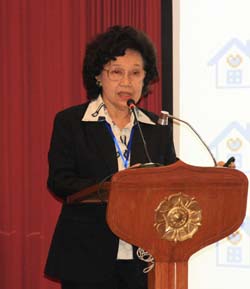 The first session was explained by Dr. Prasobsri Ungthavorm ,who share the experience and shape policy for foreign doctors in this white elephant country . Dr . Prasobsri start by telling doctors fundamental foreign policy establishment promoted in Thailand comes from the ASEAN declaration on August 8, 1967. Thailand has similarities with characteristics similar fate and between countries . This policy thus becomes the direction of solving the problem for ASEAN and Thailand in particular.
Problems in Thailand in general has similarities with problems in other developing countries. Shortage of health resources are very vulnerable place. In terms of health facilities, Thailand only has 926 government hospitals and 322 private hospitals , general practitioners and the ratio of only 1 : 4319 . Thailand aims at increasing doctors up to 1 : 2500. While the number of specialist physicians themselves only 34500.
Measures taken regarding the issue of Thailand is shaping policy universal health coverage ( UHC ) started in 2002 which has a principle of justice, equity, and has a better quality. Newborns can immediately be covered by the government. This program aims at the improvement of health services, especially in rural and remote areas. The second policy is taken form the center of medical education with the goal of increasing the quantity of health personnel through scholarship programs, public and private cooperation, the addition of specialists, to bring in experts from abroad. The third policy is the policy of accelerating the establishment of the ASEAN community study in 2015. Policy aims to solve the problem of shortage of doctors in Thailand to bring in doctors from abroa .
Dr . Prasobsri added challenges to be faced in the next era of the free market is the increasingly complex problems of disease and high mortality rates. So this policy as one of the solutions to anticipate this. Networking between the countries will work together to be an important key for the program to be on target and allows the doctor to move to the country.
Facts and policies of foreign doctors in Indonesia
Prof. Dr. Med Trihanggono Achmad, Association of Indonesian Medical Education School
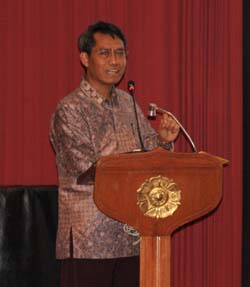 Prof. Dr. Med Trihanggono Achmad, Association of Indonesian Medical Education School opportunity in the second session on this topic to explain the policy and the situation in Indonesia related to foreign policy in Indonesian doctor and situations regarding physician needs in Indonesia.
Prof. Dr. Med Trihanggono Achmad, Association of Indonesian Medical Education School start talks on Indonesian policy for foreign doctors are specified on the doctors who have a similar level of education equivalent undergraduate and graduate school education. In addition, doctors are divided over the classification of doctors and dentists where doctors from outside Indonesia and ASEAN countries.
Multi recognition arrangement ( MRA ) in Indonesia is not much different from what is in Thailand and Malaysia. If in Malaysia and Thailand have the MRA group distinguishes dentists and general practitioners, in Indonesia two into one group. In addition , Prof. . Dr . Med Trihanggono Achmad, Association of Indonesian Medical Education School noted the role and duties of the board in Indonesia through Legislation Number 29 of 2004.
Indonesia also has implemented a policy mode 4 , which emphasizes the need for setting back the domestic rules. This policy needs to be reviewed because of the problems idi Indonesia is not the amount of force the doctor. Doctors had a considerable proportion, but has not spread to the needs in the area .
Facts and policies of foreign doctors in Malaysia
S The last session on the topic of physician migration policy presented by Dato ‘ Seri Dr . Noor Hisham bin Abdullah as a representative of the board of health of Malaysia’s policy . Hisham explained overview of the situation regarding the movement of doctors in Malaysia.
According to Hisham, the number of doctors in Malaysia is not a problem anymore, because countries such as Vietnam, the Philippines, Myanmar, Indonesia, and Egypt contribute to the availability of doctors in this country . Breakthrough owned by the Malaysian government in power sufficient for the doctor to send them to the citizens of certain countries before returning to Malaysia to serve.
Hisham in his views on physician migration policy in 2015 knew this explains the real needs to be met is perepatan of medical education itself. Countries that accelerate development of medical school, will be able to meet the minimal needs of the country are still going to doctors.
Reporter: Faisal Mansur

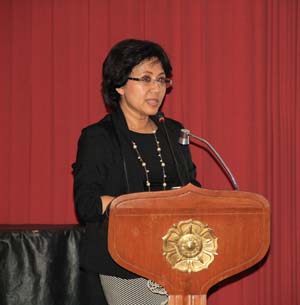 This session was given by representatives from Indonesia and Thailand. Health education in the future should be improved in order to support the ability of health professionals to face the challenges of an increasingly complex future. This was stated by dr . Ova Emilia , M.Med . Ed.Sp.OG ( K ) , PhD in the last session of the first day of the event Postgraduate Forum on May 13, 2014. Specified future not only of the exact path. According to dr . Ova , many ways you can do to improve the competence of health personnel, among others, not only related to education alone but also related to the real world. The first way is Practice based Learning and Improvement. These competencies to improve the ability to fix an error, use of technology in decision making, knowing the areas that must be improved to be more enhanced insight, skill, attitud, and maintenance processes.
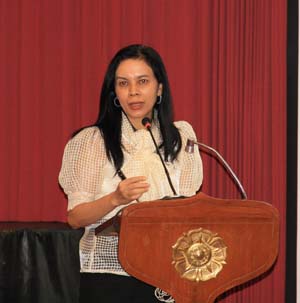 Lack of health workers in Asia , especially Southeast Asia threatens to hamper the effectiveness of health care quality health announced by the government in each country . This was disclosed by Wanicha Chuenkongkaew . the Postgraduate Forum , WHO estimates that the ratio of physicians to population if less than 2.3 health workers per 1000 population effectiveness of health care will not be achieved. In comparison with developed countries like the U.S. which touched 12.3 Southeast Asia only touched 1.6 .

 Today begins the presentation by Prof. Abdul Kusnanto with research citing Omran (1971), the three stages of modernization which are classified by cause of death: (1) Pestilence and famine; (2) receding pandemics; (3) degenaritve and man-made disease.
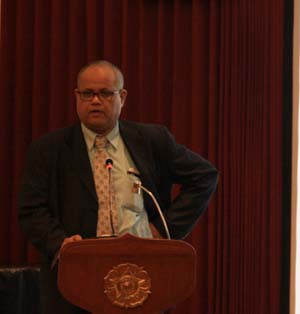 Presentation of Prof. Syed Aljunid describes how he observed UHC applications globally, which 192 countries have UHC implementation issues . He began with an explanation of what is UHC, in which he explains that the UHC is a society have equal access to health services. Then proceed with the three dimensional aspects of UHC and also aspects that affect UHC.
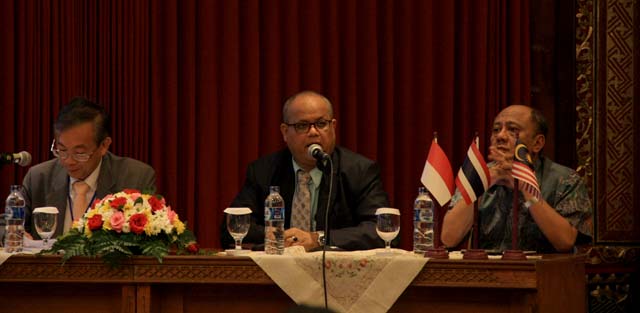

 This forum launched by Dean of Faculty Medicine, GMU, Prof. Dr. dr. Teguh Aryandono, Sp.BO (K). He highlighted the relationship between the recent findings in epidemiology and the future challenges in health sector. The challenges would be varied among ASEAN countries. Moreover, with the different international regulation on health personnels distribution, which have an important role in affecting the development of health systems and human health resource management. Therefore the postgraduate forum is very important as a media to share recent knowledge on health sectors, in particular: epidemiological transition, doctor supply, doctor migration, and various topics on health systems.
 Introduction
 The discussion series aim to:
 JADWAL KEGIATAN
 PESERTA
 PENDAFTARAN DAN INFORMASI

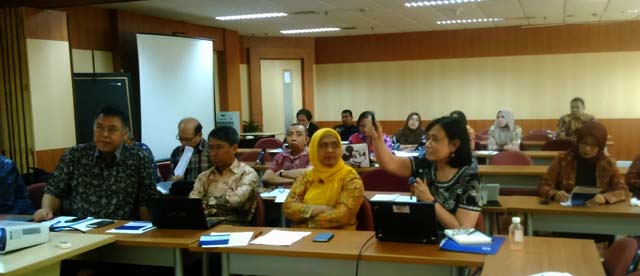


 Tujuan dari presentasi adalah membahas pentingnya dan pengaruh dari fungsi pembiayaan, menggambarkan efek pembiayaan pada equity dan efisiensi, serta mengidentifikasi isu fungsi pembiayaan di negara-negara SEAR. Telah terjadi health financing transition yang memiliki implikasi luas pada kesehatan masyarakat, equity, dan pertumbuhan ekonomi. Peningkatan sumber daya dan peningkatan pembiayaan kesehatan untuk masyarakat luas akan meningkatkan status kesehatan secara umum. Health financing transition ditandai dengan semakin besarnya pembiayaan pelayanan kesehatan di negara-negara kaya dan meningkatnya kesehatan masyarakat di negara-negara tersebut. Secara nyata, HFT ditandai dengan peningkatan belanja kesehatan per orang dan menurunnya angka out-of-pocket spending (OOP). HFT menggambarkan terjadinya perubahan pola pembiayaan kesehatan di suatu negara (
 Negara LMIC (low and middle income) memiliki konteks: pertumbuhan ekonomi yang lambat, terjadinya subsidi silang, dan rendahnya kinerja provider. Data menunjukkan bahwa pertumbuhan ekonomi di Asia mencapai 7,2% (1999-2008), namun ini hanya didorong oleh beberapa negara. Pada sisi lain, 105 juta orang mengalami kesulitan untuk membiayai pelayanan kesehatan dan 70 juta orang jatuh miskin oleh karena menderita peyakit katastropik. Dalam situasi seperti ini, banyak negara mengejar tercapainya status UHC. Saat ini, UHC status di China dan Mongolia mencapai 80% dan Indonesia, Vietnam, Philipina mencapai 60%
 Pertanyaan terbesar dalam memilih metode pambayaran adalah: pelayanan/intervensi kesehatan seperti apa yang harus dibeli (penilaian dilakukan pada 2 aspek yaitu: efek financial protection dan cost-effectiveness), Bagaimana cara membeli pelayanan kesehatan tersebut (penilaian dilakukan dengan melihat model kerjasama hirarki atau kontrak, tingkat pengambilan keputusan, dan metode pembayaran), dan dari mana pelayanan kesehatan tersebut dibeli (penilaian dilakukan dengan melihat status organisasi: public, private not for profit, atau private for profit). Pengambilan keputusan pada penetapan benefit package selalu menjadi tantangan oleh karena banyaknya faktor teknis yang perlu dipertimbangkan, diantaranya: cost effectiveness (biaya dengan QALY), ketersediaan sumber daya, dan dana yang tersedia.

